On leftovers, and dining alone...

Tuesday evening before the concert, we ate dinner at Carnevor, the downtown "Steakhouse Moderne". It really is visually, in all its acidic 70's yellow, moderne: a rack of curved logs hanging above the narrow space like a rib cage, and a classy black-dressed staff and clientele that more than a little intimidates me. I have eaten there before, but not for some time - and I credit them for my full return to red meat.

When I ate a steak there about 3 years ago, it was a near epiphany for my reformed vegetarian self. That meat was so GOOD, and properly cooked that it was an event. I've looked forward to going back ever since, though it just didn't happen until this week. My Husband had the surf and turf: an enormous lobster tail and 8 oz. steak, which he precluded with a lobster bisque. I opted for amazing pea soup with Nueske's bacon and scallops and the Strauss veal, a whopping 9 oz. that I knew before I began would be at least partially coming home with me. It was served on a bed of rainbow chard, had some baby potatoes with mushrooms on the side, and had a really nice reduced wine sauce. I ordered it done however they recommended, and it did turn out a bit on the rare side. But I knew that the leftovers could be seared to perfection, and I was right.
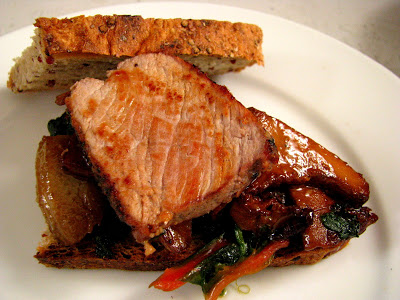


I had one small slice atop the sandwich I made for lunch yesterday out of the few leftover greens, potatoes and mushrooms. Probably one of the best leftover lunches I've had in quite awhile.

For supper last night, I made my Husband the remainder sliced and served with eggs. He topped it with an appropriate amount of hot sauce.


Tonight, I was dining alone, since we are in the throes of the NCAA tournament. I actually like eating alone once in a while, and I especially like cooking for myself. It's a liberating thing to not worry about anyone but myself. My Boy-O only wanted a couple of graham crackers with peanut butter and a pickle for supper, so I was truly on my own. After he ate, I decided I would actually cook for myself instead of picking at whatever is around - it is easy enough for me to do that and be satisfied. I had a little container of leftover creamed spinach from the Carnevor dinner, and figured I could doctor it into a pasta worthy of a dinner to myself.
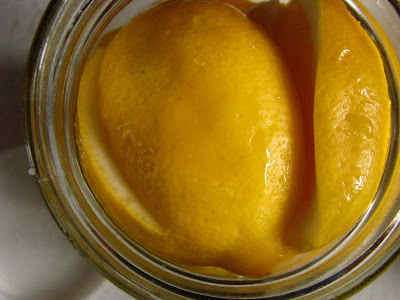


A month ago, I started a jar of preserved lemons. Preserved lemons are lemons and salt, that remain tasty and perfect for cooking with for about 6 months. Every week or so, I take off the lid and smell them, completely astounded that they are floral and deliciously lemony smelling. They are probably one of the easiest things to make, and have the biggest payoff reward. I have to thank innBrooklyn again, for making them look so delicious that I had to try them for the first time.

In tagines, which I have a particular affinity for, I always substituted regular lemons. Never again. These have such an amazing flavor and texture that they are like a exotic relative of a common lemon. My first batch was made with organic, regular lemons, but I started another batch this morning with organic, Meyer lemons which I scored from the co-op yesterday. If you are interested in making a quart jar, pick up about 10 of the nicest organic lemons you can find, a box of kosher salt, and arm yourself with a method such as this, and in a month's time you too will be swooning over lemons of all things.
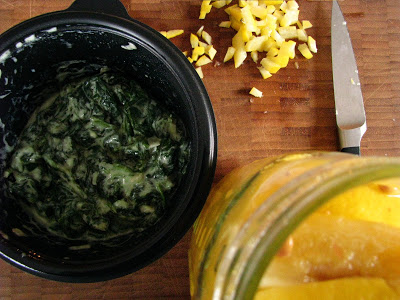


I sauteed a quarter of a Spanish onion in some olive oil while some pasta cooked, and then added a quarter of a diced preserved lemon (first rinsed well to rid of extra salt). There was enough garlic in the leftover creamed spinach to ward off a trove of vampires, so I only seasoned with salt and pepper. I tossed the warmed mixture with hot pasta, grated some Parmesan over the top and in ten minutes time, dinner was served.
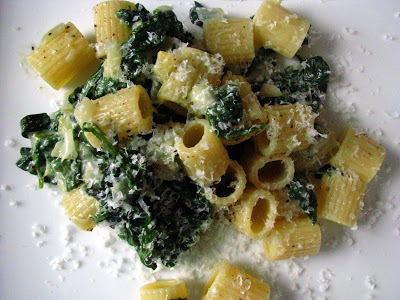


I used to eat alone often when I worked and lived the life of a blue collar person. I'd get home from a first or second shift life and usually make something for myself, eating in the quiet calm of my kitchen alone, in front of the window usually. Now that I've 5 years of marriage under my belt, it seems hard to remember those days, and the ones where occasionally I was so tired that I decided to sleep instead of eat. Anything after enough time can be romanticized, I guess, and now I almost relish a night to myself of concocted dinner - no one to please but myself. The only downside could be that instead of good conversation, my dining companions were Brian Setzer, a bit of Curtis Mayfield, and a side of Miles Davis, but even that one way conversation isn't so bad once in a while.


I know that March Madness will soon subside, Wrestlemania will be over, and life around Casa Rcakewalk will return to normal until closer to my birthday when the inevitable football begins again. Meanwhile, baseball is in there, but blessedly it is the one sport (kind of like boxing) constant enough that the DVR can be relied upon. Admittedly, I kind of like baseball once in a while, too.

It's easy to eat too much in restaurants, the portions are usually always larger than you would eat at home. I think I may be onto something ordering red meat a little more rare than I normally prefer. It caused me to eat only the more well-done edges (though who am I kidding, I did eat more than half of it), and save the very rare amount to remake. Three whole meals, and another lunch of leftover pasta tomorrow, is not bad from a small box of takeout leftovers. Just think what I could have done if I saved a bit more to take home. Maybe I'll remember that next time.
Drinking Horchata.

The first time I ever had horchata was about 10 years ago with my friend Frankee. We were at a little Mexican place in Kankakee, Illinois, and her husband ordered a pitcher for us to share. She actually didn't drink it, since she doesn't like it, but I was hooked. Ever since, I usually ask for it whenever I try out new Mexican places. Until recently, I'd only score once or twice a year, but happily it now seems easier to find. Some are thick, some light, and others gritty. Some are so sweet, and others barely sweetened at all. I like them all, poured over huge amounts of crushed ice or ice cubes. Basically, I don't care what kind it is, since it all appeals to me equally.

Really, there are three reasons for my horchata making yesterday. Last night, I went to see Vampire Weekend and the title track on their sophomore album is Horchata. I'd be hard pressed to get the opening lines out of my brain, since it has been running through my head for the past 2 days now. I also checked out this post from Glutster yesterday, and decided that his photos were so great I had to have some horchata immediately. I have a car today, and am half thinking I'll run over to El Rey and find some pureed red cactus fruit (tuna or jiotilla), so my next glass can be as delightfully rosy as Javier's. Reason three is that my Spanish teacher, Rosa, was telling me that she is eating gluten free and sugar free right now. Rice is gluten free, and I figured you could probably sweeten horchata with stevia if you felt the need, so this could be an easily adaptable drink for allergen conscious people.


Making horchata is really as easy as drinking it, you just have to have a bit of patience. One of my Rick Bayless cookbooks had a recipe using almonds, but since I was nearly out of them, I adapted his method to this recipe, by Chelsey Kenyon. Really, I ended up using both recipes, since I added milk. The beauty of horchata is that you can do whatever you like best, to concoct a result that suits you. I did use plain old refined sugar, but knocked it way back to about a 1/4 c. Rick's recipe called for 1 cup, and Chelsey's recipe for 1/2 cup. Like I said, it is purely a matter of taste.


Rcakewalk Horchata (inspired by Rick Bayless and Chelsey Kenyon)
  • 1 c. white rice
  • 2 1/2 c. drinking water
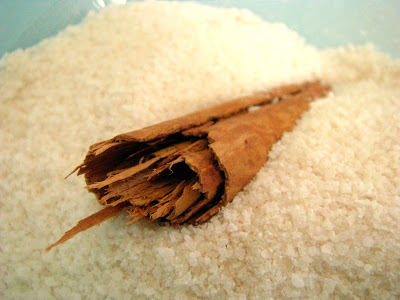
  • 1/2 cinnamon stick (canela)
  • scant 1/4 c. granulated sugar
  • 1 c. milk (2% is what I used)
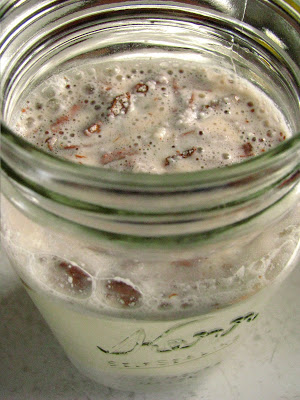
Grind the rice in a blender, or a coffee grinder like I did, until it is finely ground. You can leave the cinnamon stick whole, or break it apart if you like more cinnamon flavor. Heat 2 1/2 cups of water until hot but not boiling, and pour it over the rice and cinnamon. Let it come to room temperature, then cover and refrigerate overnight.

After refrigeration, pour the mixture into a blender. I left the cinnamon in, since I'm crazy for cinnamon, but you can fish most of it out if you prefer less. Add sugar, and mix on high for about 3 minutes until the rice is finely ground. Pour through a fine sieve (or through layers of cheesecloth and a regular sieve) to remove most of the rice pulp. (I actually like a bit of grittiness, but you could make this absolutely grit-less by using a finer sieve and perhaps running the liquid through a muslin bag.) Transfer to a pitcher.

Stir in milk. You could add more milk, or more water, or some of each, but I liked the result with just a cup of milk. You could also add additional sugar at this point if you like. Serve on ice and dream of warm weather.


"In December drinking horchata
I'd look psychotic in my balaclava
Winter's cold is too much to handle
Pincher crabs that pinch at your sandals

Whoa."


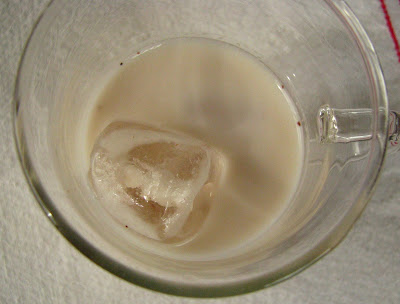
Addicting lyrics indeed, almost as addicting as the horchata itself. My milky glass below doesn't pack the same visual punch as the rosy, pecan garnished one that Glutster enjoyed the other day, but it sure hit the spot for me.


Quinoa Bread: Lahey-ified.

I must admit, that since Lahey obsession has set in, I really haven't felt like making any other bread variations. I was quite happy in making my new standby which is the Pane Integrale with a bit of extra flax meal added. Not only is it delicious and healthy, it lasts a freakishly long time. A long time if it isn't gobbled up, that is.

Well, because I was out of town for the weekend, Monday morning came with no 24 hour Lahey dough to work with. I decided to give another bread a try - since I bought this book at the same time as the Lahey book and confess to never having cracked it open until this morning. I was almost out of AP flour, which was alright since most of the bread recipes in Healthy Bread in Five Minutes a Day are predominately whole grain. When I came across one for Quinoa Bread, I knew this was the perfect opportunity to have a loaf of bread ready for my dinner deadline. And, I'm kind of a sucker for anything with quinoa in it.

The main differences in the two approaches to "no-knead" bread as I see them are these: 5 Minute a Day bread uses much more liquid and yeast, rises faster and can be stored in most cases for up to 2 weeks, and Lahey bread uses a fair amount of liquid, but only produces one loaf at a time that takes around 24 hours to complete. I

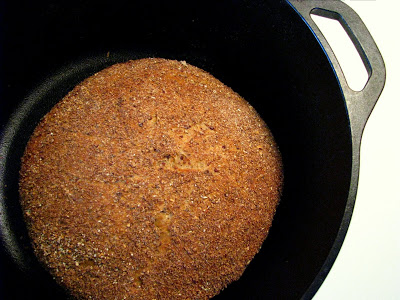
think the Lahey bread is my new favorite method as well, since it is baked in an "oven within an oven". (My new Lodge pre-seasoned 5 quart dutch oven is working out splendidly, by the way.) No messing about with pouring in water for steam, and considerably less mess, which is something of note for someone who by nature tends not to be the neatest when working with doughs. I also find that the flavor is a bit more to my liking.


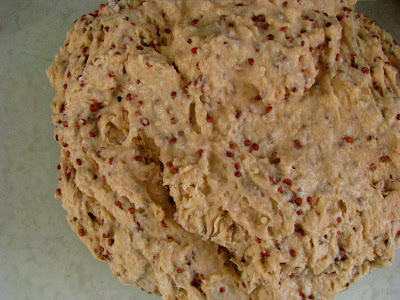
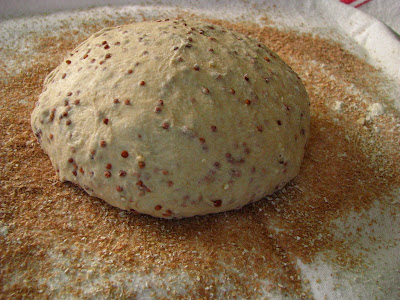
Quinoa bread dough.

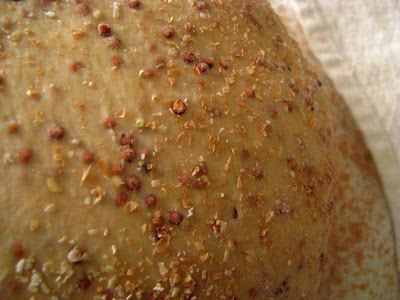
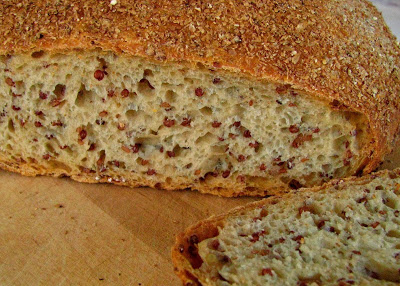
Rather than lament the omission of my bread baking in a pot, I decided to mix up the Artisan Bread in 5 Quinoa bread, and then treat it like I would a Lahey bread, sans waiting for 24 hours. My resulting loaf was still ABin5ish, but had enough Lahey characteristics to satisfy my obsessions. And it tasted great too, with the slight nuttiness of quinoa adding a millet-like texture to the bread. I know on the ABin5 website, they give tips for baking in pots, and I remember perusing it some time back, but I just used Lahey's methods and temperatures outlined in his book. I'll recount my recipe and procedure below, but the ingredient list isn't changed much from the original except that I did use half the recipe. You can easily double the dough and store it under refrigeration for up to 10 days.


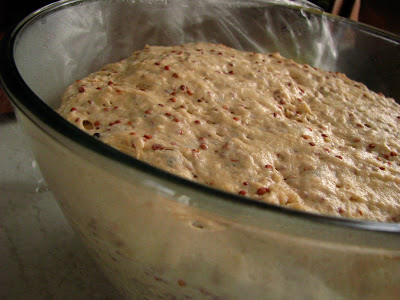
1st raising.


2nd Raising.

Quinoa Bread (Layhey-ified, but still Artisan Bread in Five Minutes a Day's recipe.)

  • 1 1/2 c. white whole wheat flour
  • 1 1/2 c. ap flour
  • 1/4 c. bread flour (you can use all ap flour, but I was out after 1 1/2 c...)
  • 1/2 c. quinoa
  • 1 t. active dry yeast
  • 3/4 t. kosher salt (could actually use a bit more, to my taste)
  • 2 T. vital wheat gluten
  • 1 1/2 c. plus 6 T. lukewarm water
Mix dry ingredients together, then add water and mix well with wooden spoon, spatula, or stand mixer with paddle attachment. Cover the dough, and let it raise at room temperature until it rises and collapses slightly, at least 2 hours. (Actual time will depend on how much yeast, how warm or cool your room temperature is, and how lukewarm your water was.)

Dust a clean linen (or non-pilling) kitchen towel with ample amounts of wheat bran and/or oat bran.

(I could have used the whole half batch of dough here for a single loaf, but I used about 2/3 of it.) Using a bit of extra flour, shape it into a round as quickly as possible, aiming for forming a tight "skin" on the outside of the dough by pulling the top around to the bottom. It's a sticky dough, so use some extra flour if you need it. When you have a nice neat boule shape, rest it on the wheat bran dusted towel, and cover loosely with the sides of the towel. Sprinkle the top of the loaf with a bit of extra bran if it seems too sticky. Let it raise for another 2 hours or so, until the loaf looks pleasantly plump, and an indentation made by your index finger lingers in the loaf after you press it in gently.

Preheat oven to 475 degrees about a half an hour before baking, and put lidded dutch oven in the oven before doing so. When the oven is to temperature and the pot is heated, carefully remove the pot from the oven, and take off the lid. Quickly and carefully, invert the loaf into the pot, trying not to "plop" it too much if possible. Put the lid back on and bake for 30 minutes. After 30 minutes have elapsed, remove the lid, and bake another 15 minutes until loaf is golden brown and sounds hollow when tapped.

Be patient, and try not to cut into the loaf until it has cooled completely.

I was happy with the final product, when it cooled and I finally cut into it and ate the heel plain for my initial discriminations. It made good sandwiches for dinner tonight, and I'm looking forward to having it toasted for breakfast tomorrow. I am also happy at the additional complete protein it contains, and that my Husband thought it "wasn't bad"! I'll call it a win, and keep it around in my bread-making repertoire. Next time, I may try starting it a day earlier and reducing the yeast down to the 1/2 teaspoon that is the hallmark of Lahey bread. Now I'm kind of curious...

Better to be a Live, Cold Potato...

There are two things I always think of on St. Patrick's Day: first, that everyone can be Irish for that single day of the year, and second that "It's better to be a live, cold potato than a dead hot tomato". I don't know why this quote sticks out, but it does... and the funny thing is that I don't even really know who said that (until in this miraculous age of Googling I found that it was probably Studs Terkel...). I assume that it stuck with me all of these years due to its absolute truth, and that it offered me some comfort since in my own eyes at least, I'm not really that hot a tomato. As I stood over my sink this evening, doing an intentionally poor job of peeling some red skinned potatoes for dinner, it was all I could think of.

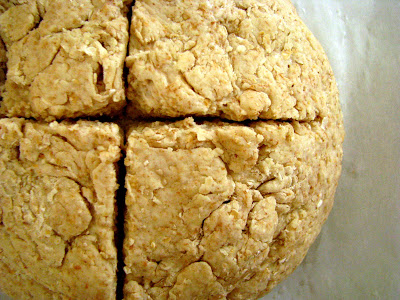
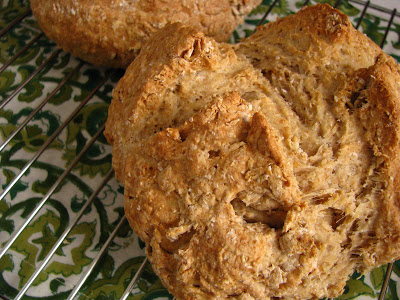
Unlike this morning, when glorious bread was on my brain. This is also the one day of the year when anyone can turn out a halfway decent loaf of soda bread, usually in minimal time and with minimal effort. Since it is a quick bread, those phobic of yeast bakery in the home can easily produce the soda bread of their dreams. The soda bread of my dreams is the recipe that we used at Gina's Pies Are Square, for serving on our busiest day of the year. I think it was from a Martha Stewart magazine, and the year I first made it for myself I had to call GOP and get the ingredients list, since when I just now quick searched the Martha Stewart website, 2022 results popped up for soda bread. This in itself is saying something. Soda bread has been done and redone, sweetened to the point of cake-dom or reduced to full whole wheat hockey pucks. But this one is the one for me.

My preferred recipe is probably not one for the record books. It's dry and crumbly and a pain to work with. The liquid is always too little, and I always end up adding more and hoping that I'm not overworking the dough. It is butter-less and dense, yet tender and tangy from buttermilk, and though boasting a fair amount of plain white flour, has a trace of whole wheat and oat bran. It was particularly difficult to mix up today, and I wet my hands down and forced it into domelike submission - a trick I learned from making biscotti.


This recipe is one of thousands you can find, but is my favorite. I feel some strange loyalty to it, and even though this one from Ina Garten was calling my name, I just could not bring myself to make it. Mine is dry and earthy, and needs something to sop up desperately. Perfect, in my book.

Irish Soda Bread - originally from Martha Stewart Magazine
makes one loaf (but I usually make two smaller loaves and give one to my In-Laws)
  • 3 c. AP flour
  • 1/2 c. whole wheat flour
  • 1/2 c. coarse oat bran
  • 1 t. salt
  • 1 t. baking soda
  • 1 t. baking powder
  • 1 2/3 c. buttermilk (you will likely need more)
Preheat oven to 350 degrees and line a sheet pan with parchment paper. Combine the dry ingredients, then add the buttermilk and form into a dome-like disk. You may need to add additional liquid, and possibly wet your hands down to get it to stay somewhat together. Cut a cross into the top of the loaf, about 3/4 inch deep, and bake for 45-60 minutes (35-45 for two smaller loaves), until the loaf is lightly browned and a toothpick comes out clean.


Ordinarily, I angelically wait for bread to cool before diving in for the first taste. Soda bread is different to me, and I let it cool just enough so that I won't burn myself slicing away at it. I love this bread, and only make it one time a year. I don't know why! It could be that it isn't really a good keeper. Two days at best, and you'll dump any remaining leftovers I'd wager. But for the one day of the year when I get to be Irish by association, I usually clobber it to the point of very little waste.


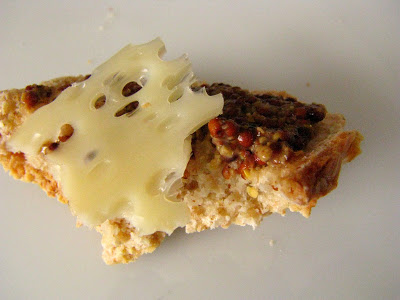
Non-Irish Swiss cheese and Spicy Guinness Mustard lunch.


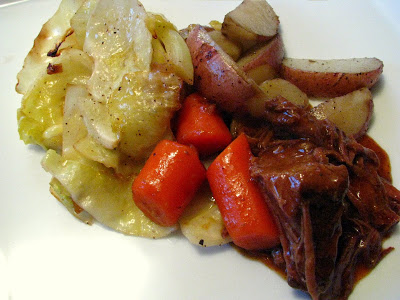
I started another batch of Spicy Guinness Mustard this afternoon, and poured the rest of the bottle into a beef stew I was slow cooking. It was intentional, since I saw this recipe recently from innBrooklyn, and thought that it would be a perfect thing for today. I was going to follow her recipe, but then didn't so much, but luckily it was fantastic anyway. I used a beef rump roast from my frozen bevy, and the aforementioned Guinness, and part of another one I saved from Monday's Oatmeal Guinness Stout Pie. I didn't add any stock, since I didn't have any, and because when I tasted the liquid after it braised in the crock pot for 5 or 6 hours, I was amazed at the complexity of the flavor. That beef is so "beefy" that it hardly needs anything to help it along. I ended up salting and peppering it well, but to my base of beef and onion, only added a few tablespoons of tomato paste, a jigger of Worcestershire sauce, and a polite splash of red wine vinegar to liven it up (and towards the end thickened it a bit with tapioca flour). I am very grateful for the leftovers, and to innBrooklyn for planting the idea in my head...


Roasted cabbage and red potatoes, to go with the stew.


When we sat down to eat, I realized that I cooked that meat for close to 12 hours in the crock pot. It fell apart and was perfect. I was actually very full after this meal. I don't often cook such heavy food, and the funny thing is that it is usually such simple food that fills you up. Irish food really is simple comfort food, and the joy of it comes from the ease of preparation and the lack of odd ingredients.

I doubt the poor farmers that popularized these dishes would have any idea the impact they would have on a girl without an ounce of Irish heritage. I'm surprised myself of how inexplicably drawn to soda bread I am, even if this live, cold potato only makes it once a year. I may have to break that habit and give a few more recipes a try.

Guinness Oatmeal Stout Pie, and In Which I Become Even More Addicted to Fudge Babies

Late yesterday, I checked the Facebook to find out that my friend Gina, the Goddess of Pie, has sold her cafe, Gina's Pies are Square. I knew it was for sale, and I knew she wanted to venture in other directions, but this floored me. Like I somehow thought all was right in the world if the pie shop was just the way I remember it, and my one-time apartment above was there just in case I ever needed it. Not that I'm thinking I'd need to escape my current life, but the time I spent in that 500 person town was a good time. I knew everyone, everyone knew me. I only had to drive to visit my Parents or to get to church, and could walk everywhere else that needed getting to.

My apartment smelled of pie, and the outside brick wall was emblazoned with a Gold Medal Flour sign. Idyllic? Kinda. I learned how to make jewelry by taking on a second job, I learned how to co-exist on a basic level when people know your business all of the time. I remembered what it was like not to have curtains on the windows. And if I saw you coming in the front door, I'd probably already have the coffee cup (or beer bottle) at the ready for you.

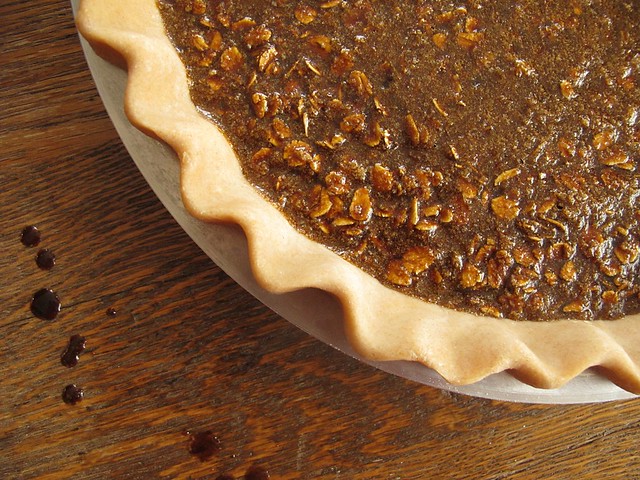
Of course, this news right before retiring for the day led me to dreaming of pie... and what better pie for Pi Day (3.14) and St. Patrick's Day than Gina's Guinness Oatmeal Stout. I'd considered making it for awhile, but knew that I'd be eating a whole pie, so didn't really know if I would be making it for sure. After reading Deena's similarly mathematical post on Coupled Pair (Pear) Pie and hearing of the changes going on at the Square Pie, I knew that in my own way, I'd make a pie as tribute today.


The good news is that if you have the Guinness, you can probably do it without leaving to pick up ingredients if your baking pantry is the slightest bit stocked.

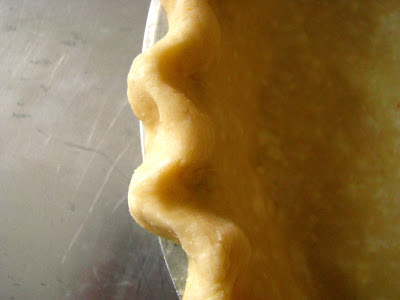
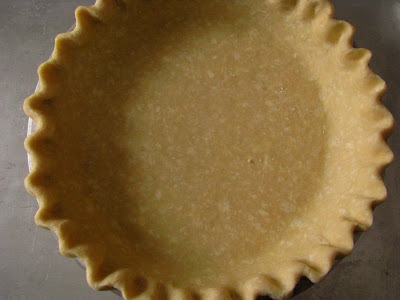
The pie recipe is one we made at the Square Pie, courtesy of the GOP.  I hope I can still call her the Goddess of Pie, since the thought of her relinquishing that crown is truly a sorry one. The crust recipe however, is from Dorie Greenspan's Baking Book. I can not believe I never made it before, because I think it is the nicest crust I've ever made. I mix it up mess free in a plastic bag as Alton Brown suggests.

Guinness Oatmeal Stout Pie
  • 3 eggs
  • 2 T. flour
  • 1 t. vanilla
  • 2/3 c. molasses
  • 3/4 c. rolled oats
  • 3/4 c. brown sugar
  • 1/4 c. butter, melted
  • 1/2 c. chocolate chips
  • 1/2 c. Guinness
Whisk all ingredients except beer until well combined, then add beer. Mixture will foam up nicely. Pour into pie shell and bake at 350 degrees for 40-45 minutes. Pie should be set and not "sloshy", but will set up a bit more as it cools... kind of like pecan pie filling. Let it cool to room temperature before digging in.

Dorie Greenspan's Pie Crust (one 9 inch pie)
  • 1 1/2 c. AP flour
  • 2 T. sugar
  • 3/4 t. salt
  • 10 T. very cold (or frozen) butter
  • 2 1/2 T. very cold (or frozen) shortening (I use Spectrum Organic)
  • about 1/4 c. ice water
Put the flour, sugar and salt in the food pro and pulse to combine. Add butter and shortening and pulse several times until mixture is like "coarse meal" and has several "fat pea" sized butter pieces floating around. Add about half the water, and continue pulsing, adding enough water and increasing duration of the pulsing a little to get the water into the flour. When the dough comes together when pinched, you have succeeded. Dump the food pro contents into a plastic bag and form into a disk. Refrigerate for 1 hour (and up to 2 days) before rolling out.


guinness pie unbaked

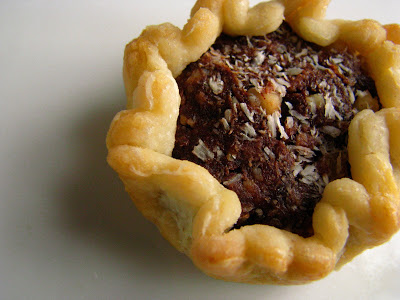
As if this Guinness Pie isn't enough to make your knees buckle, I rolled out the extra pie dough that I clipped off the crust, and figured that if these Chocolate Covered Katie Fudge Babies that I am hopelessly addicted to are good on their own, perhaps they would be even better wrapped up in flaky dough. All I am going to say is that it's a good thing I only had enough dough to make three of these (newly dubbed) Pastry Enhanced Fudge Babies.


I used a 2 5/8 inch ring to cut them out, but next time could go a bit larger. I also had to tear off (and eat, of course) about 1/3 of the Fudge Baby as pictured above, so that I could crimp the sides of the dough up around it. I brushed the edges with beaten egg, but since I only had a few, used the same beaten eggs in the Guinness Pie recipe. Nothing was wasted in my adventures, today.


It's not raw or vegan anymore, but I've got to think that CCK would be impressed that her Fudge Babies could be even more addicting!


I made a double batch of the original recipe yesterday, and used the gram measurements. I decided to sprinkle them with a bit of coconut to keep them from sticking to each other, but found they were in better proportion than when I used cup measurements. Katie also has all kinds of links to amazing looking Baby Variations. If I can get out of the original rut, I have to try some others. They are guilt-free, and beyond simple to make, and now that I know I can use up leftover pie crust with them, I may just have to make pie more often...

Good luck to GOP and her new endeavors, and farewell to the Square Pie of my past. I hope your new owners take good care of you.