Nancy Silverton and the Wildness of Bread


The beginning of bread.

I confess that I have probably read the book Nancy Silverton's Breads from the LaBrea Bakery at least ten times. I have habitually rented it from the library several times a year, long before I ever baked any bread on a regular basis. I feel like I actually know this book like I would know a person, like it has become part of my general knowledge. I even feel like I know Nancy, like I can hear her voice on the page, working through her processes in an authoritative conversational way. Thanks to a woman I met at Annie's class who was paring down her cooking library, I received a copy of my very own, and busily re-read most of it yet again in July.

I actually know whole passages by heart, including the foreword written by Ruth Reichl. In it, she describes Silverton one Thanksgiving as she arrived as her guest with an ice cream maker to accompany the pie she brought. She set it up on the floor, the only surface not being used, and nearly tripped hostess Reichl as she carried the turkey into the dining room. Why? Because ice cream tastes so much better when it's fresh, and apparently she didn't dream of making it anywhere but on the spot of it's imminent consumption.

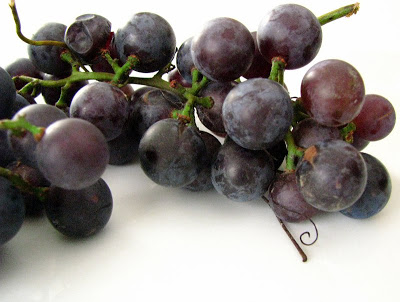
Obviously, then, I knew that if I were to attempt catching my own wild yeast and making it into something palatable, I would follow Silverton and in all of her exacting madness. Obsessed people usually make the best teachers and the writings that follow them tend to be as detailed and true as instructions can be. I collected my grapes from my Parents Farm, not only because I wanted to have organic fruit that I didn't need to worry about washing, but also because I wanted a deep Wisconsiness to my bread... a bread that has yet to be baked.
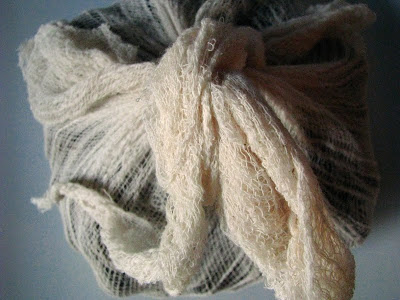


Silverton's method of starting a starter from wild roots is a 14 day process beginning with immersion of a pound of grapes in a bit more than a pound of bread flour and 2 pounds of water. I followed the weight instructions to a tee, including the temperature of the water she suggested. I didn't panic when the Concord grapes turned my contents suspiciously purple, and I did note the changes in its scent as the days progressed. Grapey-ness turned to a slightly alcoholic sour smell within several days, until by day 14 a fairly mild and uniform bread-like aroma ensued.
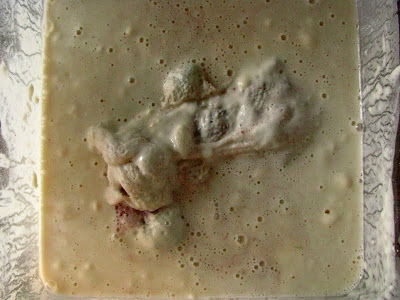

Day 1
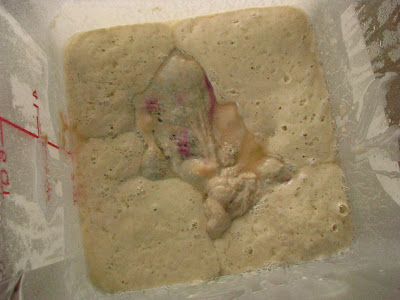

Day 2


Day 3
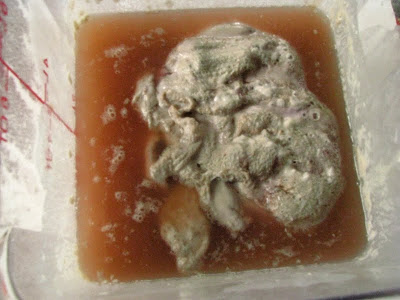

Day 4 (sorry for the blurriness on this one...)

The grapes actually stay in the mixture a whole 10 days. I didn't have any mold appear, but it is normal if it would have. After day 10, I carefully began to feed my baby 3 times a day. According to Silverton, we humans can survive on one meal a day, but really it's not advisable, so if 3 meals is better for us and our metabolisms, it is also better for our living breads. Again, I followed her methods exactly, feeding about 6 hours apart, and with increasing amounts of flour and water on each successive feeding in the day. Every new morning, I dutifully poured off all but a pound and 2 oz. of starter and started the process over again until on day 15, this past Monday, I tried to bake.
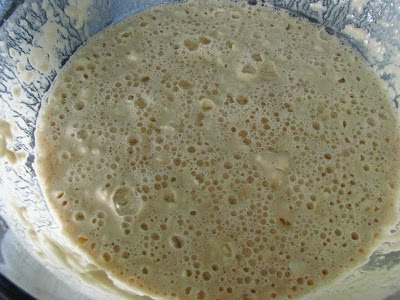

Around day 10...

It is completely obvious to me that my sourdough starter is active and alive. After each feeding, it takes awhile to bubble up, it smells sweet and good, and towards the time of the next feeding, it begins to separate - a layer of clearish yellow liquid on the top that is easily mixed in to what reminds me of a sticky crepe batter consistency. Every time I feed it, the same thing happens all over again.

But, when I tried Monday morning to make actual bread, it did not work. It felt like bread as I worked with with the dough, but it lacked any strength to leaven the dough during the first rise. After about 8 hours, and still no change in bulk, I figured I'd just pat it out onto an olive oiled baking sheet and bake it into a "focaccia" after emailing with Lo. It still didn't rise in the oven, not that I expected it to - a leaden thing that tasted surprisingly delicious with sour tang and well complemented with generously sprinkled rosemary and Parmesan cheese...
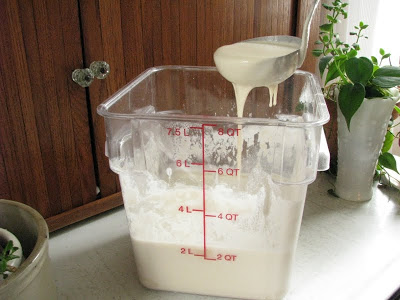


Late yesterday afternoon, I began my research elsewhere. I have no idea how to bake with my starter - especially when all seems well and living and tasty, if not proper. Meanwhile, I've decided to take my starter down to 100 grams and add 50 grams each of flour and water at each feeding for the next few days (after preliminary research here). I also need to talk to someone who has baked with sourdough I think, since no matter how much I think I know Nancy Silverton, I can not channel the wealth of knowledge that could otherwise be learned firsthand or hands on by a non-book dwelling human being. If anyone in my area (or any not-so-close reader) has any tips for me, please let me know!! Lo has already been a really great resource, but her starter is probably at least 100 years old, or even 250 - if it came from King Arthur Flour. She got it from a friend, and it always seems to work for her.

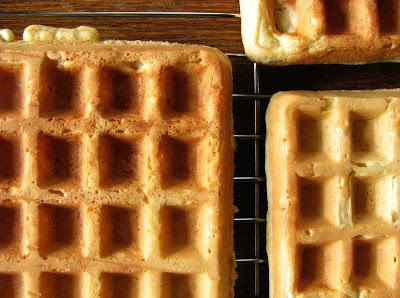
Since I have had nearly a half gallon of starter by the end of each day, until today when I decided to maintain a smaller amount, I had planned to make one of Peef and Lo's recipes: Sourdough Waffles. This morning, after I weighed out my saved starter to feed, I used a cup of what was destined as waste to make a sweet version of their delicious waffles. No bacon or cheese in here, but they were delicious when served with bananas and newly made peach butter. They were substantial, like bread, the telltale tang of sourdough that I know is alive and active beneath my uncertainty of this newborn.


I have to be out of town this weekend, so I hope I can safely tuck my little baby into the fridge where active fermentation can slow into dormancy until I get back and can resume hovering over it like a mother hen. I want to believe that it is just too young to be productive, after all he's only on day 17 of life. I like to remember that I am dealing with a living thing here, and just like my Boy-O, he's not going to do what I ask him to until he's good and ready - or is explained to that good behavior is something that is going to be expected. But maybe good behavior does have something to do with 3 good squares a day, and plenty of "cot" time. Three squares and a cot. That's what I'll try and remember as I feed for a few more weeks before trying to bake bread again...

The Lahey Project: Irish Brown Bread (and the Giveaway Winner!)

This morning, I assigned numbers to all of the commenters who desired to win the Blazing Hot Candied Jalapenos, and according to the Random Number Generator, the lucky winner was Neil F.! I met Neil at a dinner a few weeks ago at La Merenda in support of the Eat Local Milwaukee restaurant challenge. He is also an intern at Wellspring Farms, and blogs about his experiences at stream of consciousness, so hop over and check it out!

This giveaway had 18 entrants, which is vastly more than my first giveaway, and I'm very excited to see if these peppers are hot enough for Neil! I'm going to to prematurely say: yes they are!, after sampling the first of my newly canned batch last night.


I must confess that I'm really not a party girl. I enjoy get-togethers, but not feeling awkward and stranger-in-a-strange-landish. I don't attend many parties, preferring to have just one or two people over for dinner now and then. That works pretty well for me, and for my house which is on the smallish side.

I also have never thrown myself a party, which I kind of did last night, when I invited 8 friends to my house for a "Small Ferments Get-Together". We enjoyed an evening of sampling different kitchen experiments: Mr. Mork's Toungesplitter Ale (renamed The Bernadette Peters), Kir and "fermented" chocolate covered cherries (and kombucha) from Peef and Lo at Burp!, and of course an array of lacto-fermented veg and bread. (A particular highlight is that my Husband actually tried Kombucha for the first time! I was shocked! And, he didn't even hate it!)

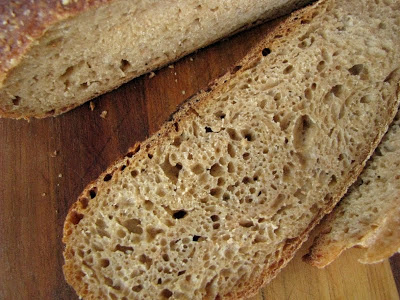
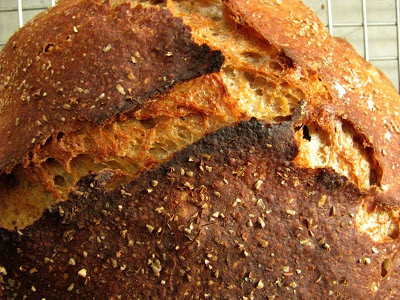
I used the excuse of company to knock out another of my Lahey Project breads: the Irish Brown Bread. The recipe is actually exactly the same as the Pane Integral bread, but instead of including water, the liquids are Guinness and buttermilk (in my case, homemade whole milk buttermilk). The result was a tangy bread with a tighter crumb than the other breads in his book, and a peculiar rye flavor even though there was not even a trace of rye flour in it.


I must admit, it wasn't my favorite of the Lahey breads I've tried so far, but Peef was on to something when he suggested a grilled sandwich made with some kind of ruben-ish ingredients! I have only 1 piece of that bread left, so I may need an excuse to make it again to try that. I also think it is largely a matter of personal preference, since a few of my guests really loved it.


I feel like I stand on the cusp of bread season. All summer, I make bread here and there, but seldom get hungry for it until the coolness of September and October hit. Nearly two weeks ago, I embarked on a new bread project, a sourdough grown from wild yeast as suggested by Nancy Silverton. If all goes as planned, I should be able to knock out the first of the loaves of Wisconsin Sourdough on Monday - and a more detailed post will certainly follow.

No matter what, Lahey bread is still near and dear to me - a perfectly wonderful addition to any dinner or party, and a fairly labor-free endeavor as well. My rule of thumb is to mix up the dough(s) 24 hours before I plan to bake. I haven't had any trouble with that method yet, but still feel like I have volumes to learn about fermentation as it pertains to bread.

Stay tuned, since Nancy Silverton is probably the best guide on the subject for an obsessive type such as myself!

More on the Lacto-Fermenting Addiction.


I am a little perplexed as I begin this post. First off, try as I might, I just can not understand food chemistry. A product of small town America, where the sciences were not stressed (except in farming matters), I just did not pay well-enough attention in my little 3rd floor high school science class... and even if I did, I'm not sure that at the time I would have found it very interesting. It's too bad, since I read this description of lactic acid fermentation over and over again, even out loud, in hope that the chemical breakdowns would make sense to me. Though I'm painfully visual, even Alton Brown's comical yet scientifically accurate approach to educating viewers on the "why" and not just the "how" of cooking leaves me smiling but still bewildered.

Obviously, then, I'm no expert then to teach anyone about the "why" of lacto-fermented vegetables. I mean, I can read recipes and see why they would taste good, but can not make out why they won't spoil in many months of cold-storage after lactic fermentation has taken place. I can tell you that the health benefits, cost efficiency and certainly the flavor involved in such experimentations are all the reasons I need to be hooked! Throw in the minimal time effort, and you have the stuff obsessions are made of.

First off, it seems to me, that pretty much anything can be fermented. A clean, quart jar (glass, of course) serves as an airtight local for the vegetable to take up residence in, and salt is added to preserve the vegetable until the lacto-fermentation kicks in. So far, I've been roughly following recipes in Sally Fallon's Nourishing Traditions. A concise excerpt she has written explains a great deal about the process and multiple benefits of this live food process.

If you are vegan and do not use whey, most of her recipes involving vegetables up the salt content to preserve the vegetable. I am hoping a science-minded reader will let me know why it is that salt can stimulate the lacto-fermentation process without the inclusion of pro-biotic rich whey, since I can't seem to make any sense of that part!


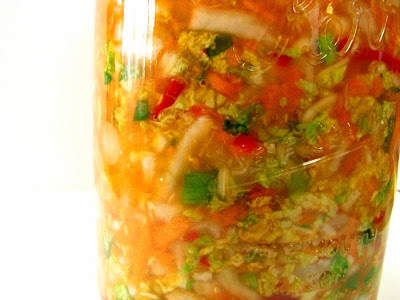
The above photos are of Sally's kimchi recipe. So far, this is the only lacto-ferment recipe that I opened after 3 days at room temperature and the jar bubbled over with excitement onto my counter. Even after the lid was off for a couple of minutes, tiny bubbles were still making their way to the surface, evidence that this is a living food. It's packed with garlic and ginger, and tell-tale heat of hot red jalapeno, an addition I just had to make. It is gorgeously orange due to the shredded carrots, a jar that just plain looks like Fall to me.

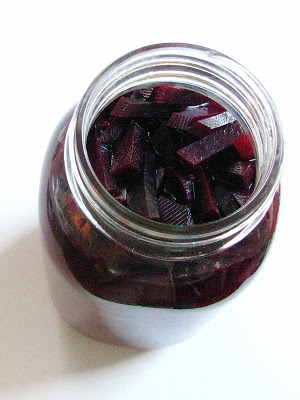
After that project matured and went into the basement refrigerator for cold-storage, I made her spiced beets which were really only flavored with the seeds of a couple cardamom pods and salt:


The liquid level should come up to over the top of these...

I opened them yesterday to check on them, but as I'm reading more I realize that I should probably curb my curiosity to checking after the 3 day mark, since oxygen interferes with the fermentation process. I even read an article by someone who was considering using an airlock method for her lacto-ferment veg. Hmmmmm. I wonder if I can retro-fit one into a canning jar lid...

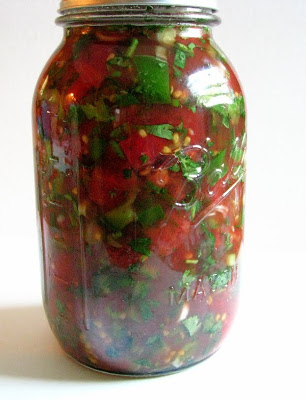
But by far, my favorite experiment so far is the "Tomato Pepper Relish" or salsa. I brought back some tomatoes from my last visit back to "the Farm", and I intended to can salsa with all of them. I did can 7 pints of hot wax pepper salsa (a recipe adapted from The Complete Chile Pepper Book), that has a vinegary base and great flavor. But then I did save out enough peeled and chopped tomatoes to get a couple of different jars of this lacto-ferment salsa:


Unlike it's canned brother, it is vibrantly dark red and packed with a whole bunch of cilantro. The flavors are so fresh and explosive since it doesn't cook at all - it just hangs out on the counter for 3 days and then goes to sleep in the fridge. I used lime juice in my second jar, and did not use any water in either of her salsa type recipes. I had quite a bit of liquid from the tomatoes, and my vegetables were fully submerged, so I omitted it. The recipe below is Sally Fallon's, and I noted any changes. For my second jar, I added the juice of one lime.

Lacto-Fermented Salsa (Sally Fallon, Nourishing Traditions)
makes 1 quart
  • 4 ripe tomatoes, peeled, seeded and chopped
  • 1 bunch green onions, chopped
  • 1 green pepper, seeded and chopped
  • 1-2 jalapenos, seeded and chopped
  • 1 bunch cilantro, chopped
  • 2 cloves of garlic, mashed
  • 1/4 c. whey
  • 1 T. sea salt
  • 1/2 filtered water (I omitted)
Mix all vegetables in a bowl, and pound lightly with a wooden spoon. Place in a quart size wide mouth mason jar, and press down until liquid completely covers the tomato mixture. Leave at least 1 inch headspace in the jar. Cover tightly, and keep at room temperature (70-75 degrees) for about 2 days before transferring to cold storage (about 40 degrees).

As I quoted Fallon in my first lacto-fermentation experimentation post, your nose is your guide to how long these jars will be good in cold storage. I think several months is a given, but the few jars I've made will likely be fully consumed long before that. I hope to make time to get several more jars packed away with the last of Summer's wealth of fresh and local vegetables, and let them hang out for a while before eating them. I will say that it does take some re-tweaking of my brainwaves to remember that this food preservation method pre-dates any home-canning method and is a viable home-preservation method. I love this quote from Sandor Ellix Katz in his book Wild Fermentation, and find myself using it more all the time: "Cleanliness, not sterility". If you keep a clean home and a modicum of common sense, lacto-fermentation is probably the easiest form of home preservation you could experiment with!

One extra benefit is that you don't need to understand the science to know that it works, and that the results are delicious - good thing for me!

A Vegan Return: Chocolate Mint Cookies (and A Giveaway!)


So, I ran into Lindy yesterday at the library. Boy-O and I stopped there as we were walking back from school. It's funny, how a 2 1/2 hour difference in my day's "schedule" (or really, lack thereof) has really thrown us all for a spin. Suddenly, I'm only able to sleep for about 6 hours a day, since my body can't go to bed early, yet insists on waking up at exactly 6:15 a.m - a good hour before it actually is now "required" to be awake.

I haven't seen Lindy since January - an amount of time that seems impossibly passed but was thoroughly confirmed by the growth of her baby, who was born on Christmas Eve last year. I actually first met her at the Library playground about 2 years ago, where she asked me if I ever went to the story time for the kids. It so happened, that I started going regularly - and I used to see her fairly regularly as well. We liked to chat about foodstuffs and I eventually told her about my blog... and then soon after, I had my first reader giveaway.

Ever since, I've been a little leary of having another giveaway. My online popularity may have grown a tiny little bit since those earlier days, but my first giveaway was truly kind of funny. I had made a jelly out of POM pomegranate juice that I received to experiment with, and I was certain that commenters would come out of the woodwork to be gifted a jar. My ego was knocked right into place when my ever-popular self witnessed exactly 2 people threw their hats into the ring... and one was my best friend, Sasa. But, Lindy won, and I was happy that she did, and that she liked my POM Jelly, and that we have continued to chat about foodstuffs when I run into her at random.

Yesterday, she asked if I was still going to do my Vegan Monday postings. While I do like to have purpose and focus to my kitchen experimenting, I've just felt so busy lately that I hate committing to anything! Most of it is self-created work, but I think that with the newness of school, the coolness of early Autumn, and that year older I suddenly got, time is making me feel exceptionally harried. That said, her little comment yesterday made me pause to think when I turned on the oven in the afternoon to make some cookies... while I was at it, I figured I may as well make them vegan.

Vegan baking in particular always brings a smile to my face. I somehow feel positively guiltless, which is a perfectly wonderful thing to be when dealing in dessert.

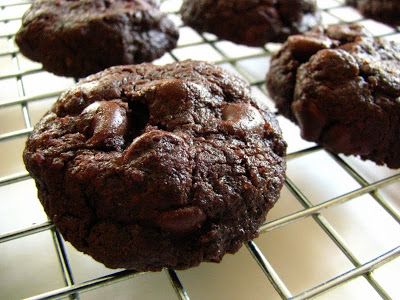
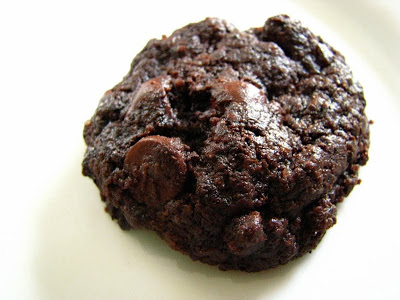
I'm newly experimenting with both coconut oil and raw sugar, so I figured both would be happy partners in some chocolate mint cookies. I was right, since the raw sugar leaves addicting crunch in those deeply chocolate bites. If you are looking for a baked good that you could mail across country, these are not your variety. They are fragile and a bit crumbly, and they also cause a fair amount of paranoia, since you will find yourself glancing over your shoulder to see if anyone could be offended that you are literally shoveling bite sized chocolate cookies into your mouth.

I'm fairly sure the leftover half-bag of mint chocolate chips I had were vegan (I couldn't quite see all of the ingredient list since I had cut the bag open), but you could easily substitute any other vegan chips you like. I also technically made half a batch, since I only had about 5 oz. of chips left. My yield was 22 cookies, but you could easily double this recipe.

Vegan Chocolate Mint Cookies (adapted from the back of the Hershey's Mint Chocolate Chip package)
  • 1/3 c. coconut oil (not melted, but room temperature)
  • scant 1/2 c. raw sugar
  • 1 flax egg (1 T. flax meal mixed with 3 T. water)
  • 1/2 c. flour
  • 1/4 c. cocoa powder
  • 1/4 t. baking soda
  • pinch of salt
  • 5 oz. mint chocolate chips
Preheat oven to 350.

Beat the coconut oil with sugar until well blended, then blend in flax egg until well combined.

Sift together flour, cocoa, baking soda and salt and mix into wet ingredients. If the mixture is too dry, add a tablespoon or so of water to help it hold together. Stir in mint chips.

Form into disc shaped cookies, (about 1 1/2 T. per cookie), and bake for 8-10 minutes. Let cookies cool completely on sheet before removing them for storage. Or better yet, eat them whilst they are still hot, perhaps with a scoop of rice dream ice cream...


Seeing Lindy yesterday also reminded me that in the spirit of sharing, of Autumn and extremely hot jalapeno peppers, I did want to try my hand at another CakeWalk giveaway. This time, I will not be disappointed if I don't get many commenters, since if you comment to win this pint jar of Candied Jalapeno Peppers, you had better absolutely *LOVE* hot foods. When I was visiting my Parents last weekend, my Mom and I talked briefly with an Amish woman who mentioned that the more overgrown the peppers are, the hotter they are. "Oh, really?", I said. That would explain why I have the hottest candied jalapeno peppers on earth! It's not going to stop me from eating them, however, even if it means that I have to use up most of them in cooking. (Like my Mom said, most Mexican food can stand up to a little sweetness.)

Since technically this is a vegan post, I should also mention that it seems the jury is out on whether or not sugar is vegan. The brand of raw sugar I use is Golden Barrel, and I did not see it listed in the products on their website. I bought it at the Amish Bulk Store, in the middle of the country, Southwestern Wisconsin. So, if you are vegan, but not too picky, I encourage you to try and win these hot babies! They will no doubt put an extra kick in whatever you are up to, vegan or not.

I will choose a winner using the Random Number Generator on September 18th, so please leave a comment before midnight on Friday, September 17th 2010 to win your very own jar of supremely hot Candied Jalapenos! You can check back at my recent jalapeno post to see just how they were made, and also find the recipe should you want to make some yourself. I'd like to also include a batch of Vegan Chocolate Mint Cookies, but I know they'd never make it to you. Besides, I'd probably eat them all before I had time to box them up...

Good Luck!

Of Birthdays, Fine Dining, and Onions.


Yesterday, I gained a year. As a child, I couldn't wait for my birthday. The weather was usually just about to turn into the coolness I preferred, the new school year seemed exciting and full of fresh pencils and Trapper Keeper folders, and there was always a big family celebration to look forward to. My Mom's youngest brother is just 10 years older than me, and his birthday is at the tail end of August, so typically, we used the dual birthday excuse to have an enormous picnic. Most of my maternal side extended family all lived within a few miles of each other, and in the Great Northwoods of Wisconsin, there were plenty of lakes and picnic areas to choose from.

Earlier in the summer, my Mom would suspiciously take out the Wilton Cake Yearbooks (years 1977 and 1980) for my younger brother and I to look through and pick out which cake we would want for our birthdays, both upcoming in September. We would carefully pour over the pages, dreaming of moat surrounded castle cakes, giant robot cakes with pink and grey frostings, igloo cakes with penguins fishing in an icy blue pools of gel color. It took us quite a few years to determine that my Mom was really only going to make us one of three types of cake from the limited cake mold supply she had: a dome that became the dress of a doll when a clean and naked Barbie was standing in the center and frosted over with icing, a train painstakingly decorated with our pictures cut out in the windows, or a bear with his hand in mouth - the cake that all three of us had for our first birthdays. Now I know, that Mom was keeping us happily occupied for hours with those cake books, stimulating our imaginations and helping us dream of our birthdays, the most special day of the year.

I have the Wilton Yearbooks in my kitchen library, and nothing could convince me to get rid of them. I've sat with my Boy-O and carefully paged through them, helping him to be careful with the pages, since with every year, they get a little more fragile. Now, I tend not to get as excited about my birthday, not for any particular reason. I'm not all that afraid of aging, but I do feel a tinge of sadness thinking that no matter how much I wish as I blow out a candle, I can never return to my Mom's kitchen and those days of childish imagination.

Because I love to cook, I spend a good 90% of my weekly stipend on ingredients and sometimes frivolous (see: culinary torch) implements to expand my amateur abilities. I'm sure if I wanted, I could make all the excuses in the world to go out to eat, especially since my Husband loves dining out, but almost all of the time, I'd rather concoct things myself. We eat out on occasion, but rarely go to eat at fine dining establishments, saving it for such special occasions as our anniversary and my birthday.

For the past couple of years, my birthday has become a food event that I look forward to for weeks in advance. I can pick wherever I want to go, our budget is gloriously lifted for one precious evening, and I feel, at least for a few moments, like I'm a Rockefeller. Normally, I keep budget in mind, as a loose way to keep myself from being frivolous and free with cash. But because our fine dining experience is truly limited to a couple of times a year, the splurge always pays off in so many ways.


In When Harry Met Sally, (the late) Bruno Kirby was a columnist for New York Magazine who said "Restaurants are to people of the '80's what theater was to people of the '60's." I often think of this when I eat at a restaurant, especially a fine dining restaurant. Since I was just a kid in the '80's, and I lived in the rural Northwoods, I didn't do a whole lot of eating out. We ate very well, but not outside the home too often and just homemade, homegrown, home preserved and generally wholesome foods that weren't too fancy. My limited experience in the restaurant scene of the 21st century leads me to believe that it is like theater and art and gastronomy all rolled up into one.

This year, I chose Harbor House for my birthday splurge. Recently opened in July, I read this review by Carol Deptolla and tucked it away back in my mind. I sometimes enjoy reading restaurant critique, but not always so often, since I really believe that so much of an experience is relative. I mean, I know how to poach an egg for example, but the experience of ordering the egg, being served the egg, noting the placement of the egg on the plate, and eating the egg in an exceptional environment changes that lowly egg considerably. Where am I going with this? Deptolla is curious of the New England decor of the Harbor House, but I thought it was so gorgeous and well designed that it only added exponentially to my dining experience. Our food was amazing, perfectly prepared and gorgeous on the plate. Service was exceptional, as always at Bartolotta restaurants (not that I have been to them all).

I could go on and explain our meals, the way our raw oysters sat in the ice and challenged me (I ate three of them, and was not allergic, so that was a plus), that our supremely nice waitress brought me a sample of both pinot noirs by the glass, since I told her I never had tried one from France (Oregon won out - even at twice the price), and that watercress served as a condiment with beef and scallops is delicious and palate cleansing between bites. But I'll bet your experience would be different so I won't elaborate too much. I'll just say that when I get done eating and I'm so supremely happy, it's the best gift that anyone could ever give me - whether I've just sat in a window seat overlooking Lake Michigan, or at an enameled thrift store table in my best friend's kitchen.


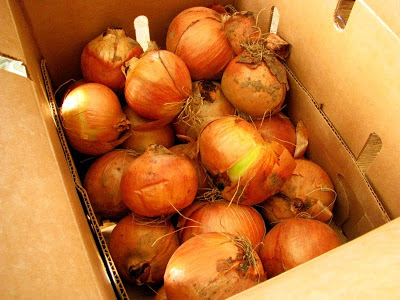
While yesterday seemed to be full of spluge and excess, I remembered as we picked up our CSA box on the way home about the frugality that is usually my credo. In our weekly newsletter last week, our CSA mentioned that they had "grade B" onions to give away to anyone who desired. I emailed that I'd be interested after texting my Mom. Our exchange:

me: 20lb boxes of grade b onions (organic) free for the asking?!
Mom: Sure, for free you take, for pay you ask questions :)

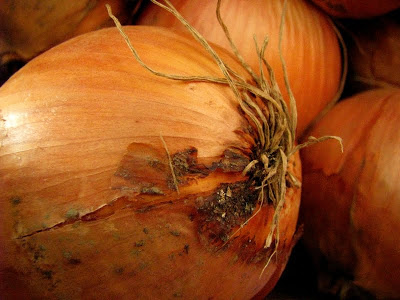
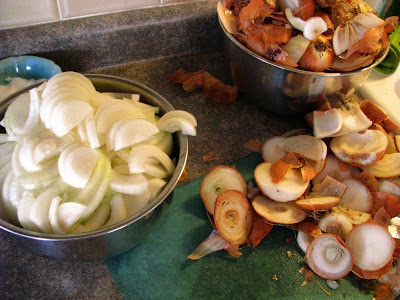
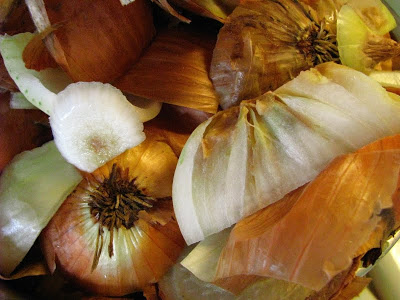
That is the resolve with which I was raised. For free you take, and you make wonderful with. I didn't know exactly what I would get when I cut into the first onion today. They were soft, even mushy in parts. Each one was different and I found myself thinking about human nature once again as I cut into each one. Some had good centers, but layers of rot and decay surrounding them. Others had a few layers of superficial goodness, and rotting hearts. It was impossible to tell from the exteriors. Each one had a good and salvageable part, even if it took streams of tears down my cheeks as I sliced my way to the end of the box. I thought of the salad I ate at dinner last night, perfect specimens of tomatoes and red onions, thinly sliced and without blemish. How wrongly we think that to be edible, food has to be blemish free and gorgeous not steadfast and workhorse-y, with just a bit of extra work to be done to make them extraordinary.


I really had no idea what amount I would end up with! It was a fun and free adventure that reminded me that "peeling an onion, you find a lot of layers". The onions were soft, but not awful, their smells a clue that the rot was not malicious, just due to too much moisture or something. I weighed my final amount, and got 3 lbs, 10 oz of sliced, clean, organic onions, from what otherwise would have been garbage. I composted the rest, so that really nothing is wasted. I decided that I wanted to make caramelized onions.

By 9:30 this morning, all the onions went into the slow cooker with just a little olive oil. I'll add some black pepper and maybe a drizzle of balsamic vinegar or a pinch of brown sugar, maybe some thyme after they cook down a bit more. It's been about 5 hours at this writing, and they smell amazing and sweet and are filled with soft, oniony liquid that is quietly bubbling away. I check in and stir it every so often, and this cool front that has finally graced us allows open window and a sweater to be the perfect accompaniments to the syrupy onion smell that is intensifying as each hour passes today.

Nothing could be more comforting as I peel another year off of myself and go forward. Onions smell like home, that's for sure. It's good to be reminded that there is usually more to a person than meets the eye. I'm sure it is true for the baby-faced line cook I was observing from my seat in the dining theater last night. I wished that I knew I loved to cook so much when I was his age, and to be in kitchen whites in full sight of such a gorgeous view of the city and lake so early in my career.

It still seems funny to think that I can now clearly remember 20 years ago, and while I wish I could have figured out what I wanted to do about 10 ago when I was flailing my way around the college system, I have no regrets. I can peel an onion with the best of them, and I'm happy doing it. And I can do what I like with the good and scraps alike: hopefully turn it all into something good.