Vegan Monday: Tofu Scramble (and Bonus: Sweet Potato Smoothie)


I sometimes wonder if my library sees my check-out trends and stocks new books just for me. On our weekly trips to the library, Boy-O usually dictates the time that I can spend looking at books for myself, but usually is able to use his "library voice" long enough for me to at least peruse the New Books shelf. Last week, I was excited to find a brand new vegan cookbook: The Vegan Table by Colleen Patrick-Goudreau.

Colleen's book is a guide to vegan entertaining, and recipes are organized seasonally and by occasion. It's full of great photography and recipes, exactly the type of cookbook that I can read cover to cover and then drop into my endless Amazon cart since I know it will continue to be an inspirational addition to my kitchen library.

So, early this morning when I was "Vegan Mondayless", and awake bright-eyed at 6 AM instead of bleary-eyed at 7 thanks to that daylight savings time, I decided that I had to make a tofu scramble for breakfast. Tofu scrambles, or the vegan approach to scrambled eggs, are things that I've eaten out numerous times, but for some reason have never made at home. The scramble in The Vegan Table looked so good when reading about it late last night, and since I had it on two accounts with recently reading a similar recipe in the VitaMix cookbook, I felt more than confident that a good breakfast would ensue. Well, needless to say, I loved it... and now know that I will probably be making it a lot using up all kinds of different veggies.
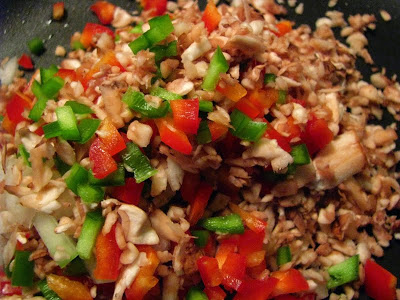


Now, I should note that I wish I had a bottomless appetite. The truth is, it usually doesn't take much to fill me up. I used a half recipe (amount from The Vegan Table) which should have fed me, one person, but it actually could have fed me twice. That's OK, since now I have tomorrow's breakfast taken care of...

Vegan Tofu Scramble (adapted from The Vegan Table and the Vita-Mix cookbooks)
serves 1-2, easily doubled
  • 8 oz. firm tofu, crumbled (not silken)
  • 1 T. olive oil or water
  • 1/2 onion, chopped
  • 10 crimini mushrooms, chopped
  • 1/2 - 1 red or green (or some of each) pepper, chopped
  • 1 clove garlic, minced (or pinch of granulated garlic)
  • 2-3 leaves fresh spinach, coarsely chopped
  • 1/4 t. turmeric
  • 1/2 t. cumin
  • 1/4 t. paprika
  • 1 T. nutritional yeast
  • salt and pepper
  • (optionals: chopped jalapenos, diced tomatoes or salsa, red chile flakes... etc.)
Heat olive oil or water in a large pan over medium high heat. Saute onion, mushrooms, garlic and pepper(s) until softened. Stir in crumbled tofu, spices, nutritional yeast and spinach, and saute about 5 minutes until tofu is bright yellow, and heated through. Season with salt and pepper.

I ate half of the above portion with a Black Bean Tortilla that I had made the other day using some leftover pinto beans. The tortillas are also vegan and freeze well.
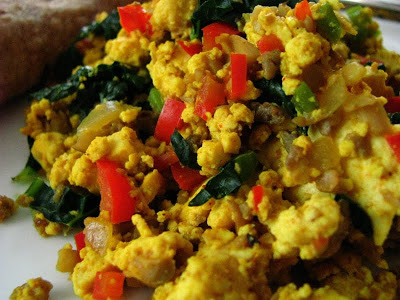

Tomorrow's breakfast.

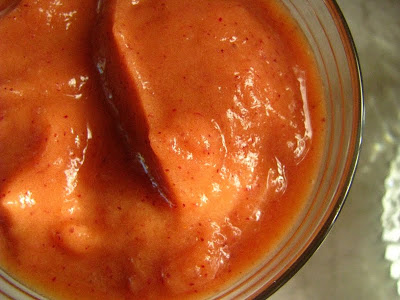
Happily working through my morning organizing my house and paring down clutter before Winter comes, I eagerly anticipated this smoothie for lunchtime. Yesterday afternoon, I roasted some sweet potatoes (whole, in their skins at 400 degrees for about an hour) with this recipe in mind. It is in the VitaMix cookbook, and I never would have imagined how delicious it is. So good in fact, that even if you don't have a VitaMix, it would be worth trying to approximate in a food pro or with an immersion blender. But hey, if you live in Milwaukee, just stop in so you can share one with me!

Autumn Sweet Potato Smoothie (VitaMix cookbook)
makes 2 generous cups (I drank one glass, and saved one glass for later...)
  • 1 c. red grapes
  • 1/2 medium orange, peeled
  • 1/2 sweet potato, cooked and cooled
  • 1/2 medium apple, halved
  • 1/4 c. fresh or frozen cranberries
  • 1/2 t. fresh ginger root (I love ginger, so I used a two inch section of ginger root, roughly chopped)
  • 2 whole pitted dates
  • 2 c. ice cubes
  • (I also added about 1/4 c. water)
"Place all ingredients into the VitaMix container in the order listed and secure lid. Select Variable 1. Turn machine on and quickly increase speed to Variable 10, then to High. Blend for 1 minute, or until desired consistency is reached."


Every once in a while, one part of a whole makes me feel like alone it is worth the price of admission. That is how this smoothie is. Like if it was the only thing I ever made in my new machine, it would be fully worth astronomical VitaMix pricing. (Though, in all reality, I couldn't be happier with my machine. It stands up to it's hype, is worth it's price, and impresses me daily - so consider me a proud spokesperson!)

I was thinking about Mark Bittman today, and how he likes to "go vegan until 6 PM". I guess that would be 5 PM central time, and I'm well on my way for today anyway. It is an intriguing idea for those of us omnivores who tend to be heavy on the veg side of things. If it wasn't for my leftovers, that often loom large for me to clobber days after a meal if I forget to appropriately scale down, I would certainly be able to commit to this diet myself!
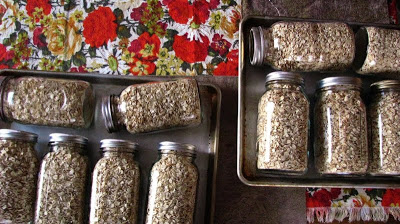
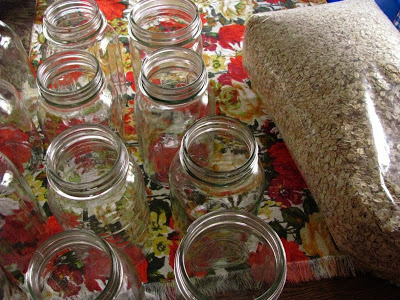
Long Term Storage: Canning Rolled Oats.


It may not seem noteworthy to think about stocking dry goods in bulk, but I'd like to make a note of it anyway. For the me who is now an urban dweller, the phrase "making hay while the sun shines" doesn't hold the same feeling as it did when I lived rurally. I think back to when I first moved to the city, and only went to the grocery store every 3 weeks or so. This was the way we always shopped as I grew up, and for many years, it didn't occur to me that I could shop a few times a week if I wanted. Rurally, there wasn't really an option of running to get one forgotten ingredient, or just swinging by the store on the way home. Well, as I grew older, there was the option, but the store likely didn't have what you needed anyway. The small community closest to our home during my teenage years was really a place to get the occasional banana or box of cereal, and even then was very expensive. We tended to live off the pantry, and one shopping trip "to the city" every month.

In my adult life, my personal focus on preservation tends to be on things that were staples to me growing up: most specifically dill pickles, applesauce and tomatoes. Every year, I seem to add things that I now can't live without, Marisa's dilly beans and candied jalapenos for starters. This year lacto-fermentation was on the docket, and depending on the shelf lilfe, which has yet to be determined, I can see doing a lot more of it in the future. But no matter how much I feel like I have already preserved, I feel like I can always do more, like I am a "hoarder" of good whole food. Bulk (dry) storage hasn't really even been in the back of my mind, but it is always nice to know that I have bulk grains and now even raw sugar stashed in the basement.

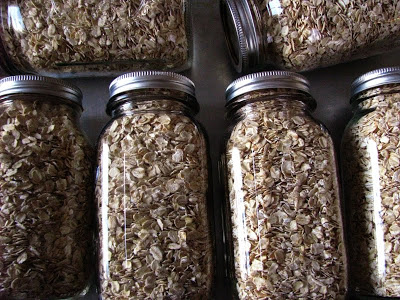
When most of the year, organic oats at the co-op run near $1.50 a pound, I now seldom bat an eye knowing full well that I have quart jars full and sealed, just waiting for my breakfast and baking needs. Between my Mom and I, we usually secure a much lower price by buying in bulk - usually 50 lb. bags from her co-op in LaCrosse. In years past, my Mom would can the dry rolled oats, and then I would barter them from her, usually with pounds of Alterra coffee and quarts of toasty granola.

But recently, I was able to secure the best price on rolled oats from my co-op, so I purchased 60 pounds at 89 cents a pound, and am dry pack canning 30 pounds myself for the first time. My Mom has dry canned oats for several years, and really it is the easiest thing. Simply heat the oven to a low 225 degrees, fill quart jars with oats to within 1/4 inch of the top, and top with lids and rings. The jars can "bake" on their sides for 45-60 minutes. Remove from the oven, stand them carefully upright, and be patient for the "pop" of the lids. It takes just a bit longer (or, requires a bit more patience) to hear than the pop of the water bathed or pressure canned goods, but once sealed, it's a great feeling to know that the oats are safely sealed from moisture and pests. If you have some that don't seal, you can use them first. (My first batch of 12 quarts, or 10 lbs. of rolled oats had 4 non-sealing quarts. On my next batch, I plan to gently wipe the rims with a clean, lint free cloth to see if I can improve my sealant ratio.)


Outpost conveniently packaged the sale oats in 10 pound bags, easier on my back...

Upon a bit of research, I have found that dry pack canning can also be done in tin, and with any dry good that is less than 10% moisture. I like the idea of storing in glass, and have ample glass jars to use. Tin cans also require the use of specialized sealing equipment that may be available to rent in some areas. If you are interested in keeping the food "raw", this site recommends packing the jars with moisture absorbers, and avoiding any heating process. It seems to me that this method would be preferred for those trying to preserve the growing power in grains or beans, since you would not compromise their vitality.

Dry pack canning in the oven is also a good way to preserve nuts, though I have not tried it yet. I think I may try it with raw nuts and see how much "roasting" I get by the low oven temperature. Last year at Christmas, I made a few batches of these delicious nuts from Food in Jars - and I am curious if I could seal them using the dry pack method. I'll be sure to update this post after my experiments...


Update: 11/9/2010

Last night, I sealed another 12 jars (11 quarts, and 1 half gallon jar) using the same dry pack method described above, and achieved 100% sealing. Before fixing on the lids and rings, I brought the lids to a boil, and let them sit for 10 minutes to soften the seals. I also wiped the tops of the jars with a lint free cloth before topping them with the lids and rings.

When canning in a water bath or under pressure, you should never disturb the jars as they cool. But since we are talking about sealing a dry good, there are no such issues to be concerned with. When the jars were nearly room temp, and some still had not sealed, I borrowed a technique no longer recommended for jam making: I turned them upside down. I think I had 5 jars that I inverted, and by this morning, all of them had sealed. (My sealant test is to lift each jar by the lid only.)

Applesauce Cake, a.k.a. Spanish Bar Cake.


Growing up, it is safe to say that we were a dessert family. There was a Boston Baked Bean crock, seldom devoid of cookies, that had permanence on the edge of the kitchen counter. I could usually hear the telltale rattle of the pottery lid just after my Dad would step in the door from work. Now that I'm an adult and a parent myself, I can appreciate that my Parents wouldn't ordinarily let us kids indulge before supper ourselves. I think of Jerry Seinfeld saying " as adults we understand, even if you ruin an appetite, there's another appetite". If we adults want, we can go ahead and squander our current one on as many cookies as we can hold.

That, my friends, is probably why I don't keep a cookie jar, and save the bulk of my cookie baking for Christmastime. Cookies are just too small and bite sized for me to resist. Cake, however, I am (usually) dutifully able to ignore until after dinnertime, when proper adults who have eaten responsibly for the day are free to indulge. While the family of my childhood always had cookies at the ready, my Mom also frequently had other desserts for those of us who ate our dinners. Cake, pie, kuchens, coffee cakes that were flaky and shaped like enormous tennis shoes (oh, but they were sooooo good!), fruit cobblers or crisps, rice puddings or tapioca. Seldom were we to end the evening without a few bites of something sweet.

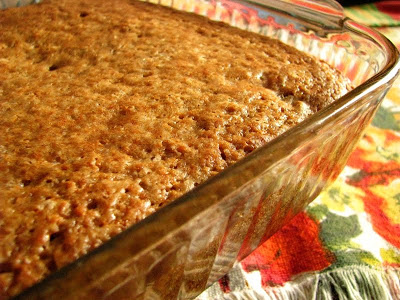
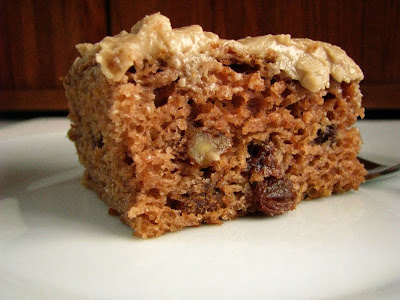
One dessert that my Mom often made, also a favorite of my Gram, was this applesauce cake. They both made it in a 9x13 aluminum lidded pan, also with the telltale lid rattle I could hear from a mile away. Most families have a cake or two like this, ones that are made entirely of pantry staples and remind them instantly of home. For me this is that cake. While I most love chocolate cake, this is the cake that takes me straight back to the Northwoods, my Gram's kitchen. Her silver percolator of coffee hot, and this out of the oven just long enough to be frosted in maple cream cheese frosting. We had plate sized pieces, the bunch of us satisfying that Mendez sweet tooth heartily - and with ample amounts of vanilla ice cream alongside it no doubt.

My Mom grew up in Chicago area, a south suburb that at the time was almost rural. She remembers her dad picking up a cake similar to this at the A&P every Sunday and it was called Spanish Bar Cake. My grandfather was Mexican, so when she told me this years ago, I just figured it was something that he affectionately called this moist applesauce cake and didn't consider that the A&P store did actually have a cake of the same name. It's also true I hardly know what an A&P store was, since where I grew up there were no such things.

It's unclear to me the exact origins of our cake recipe. The A&P version (according to many Google perusals) was a dark spice cake with a fluffy, white frosting. Some recipes use molasses or a tablespoon or two of cocoa powder, but all use applesauce and shortening or oil and no butter. Most are studded with varying amounts of walnuts and/or raisins. I'm certain our version comes from a newspaper somewhere over the years, and was written down in my Gram's lovely cursive on a 3x5 index card that has yellowed and browned over time. Our instructions call for the use of a pint of applesauce, since my Gram's tree had, and still has, the best of the best apples for sauce.


Last year's applesauce, from Gram's tree... just a few pints remain before the 2010 batch kicks off.


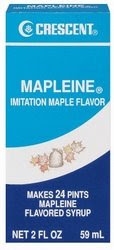
This cake is topped with a cream cheese frosting flavored with the artificial maple flavoring, Mapleine. As far as the fake stuff goes, it is my favorite. It's a molasses-black bottle made by Crescent and it really isn't all that artificial. It's caramel colorant makes the otherwise snowy frosting into a rich, fall-like color, and it's syrupy sweet maple essence is the key to the Mendez version of Spanish Bar Cake. I was also able to make powdered sugar out of my raw sugar for the first time thanks to the new VitaMix. Even though it was completely powdered, the finished frosting had that crystalline raw sugar bite that I really love. I think everyone in my family knows how to make this frosting, and we never measure, we just add liquid and powdered sugar until the frosting feels like frosting. I will approximate the amounts below.

.

Spanish Bar Cake (a.k.a. Applesauce Cake)
one 9x13 pan (easily halved for a 9x9 inch pan)
  • 2 1/2 c. ap flour
  • 2 c. sugar (I used raw)
  • 1/4 t. baking powder
  • 1 1/2 t. baking soda
  • 3/4 t. cinnamon
  • 1/2 t. cloves
  • 1/2 t. allspice
  • 1/2 c. shortening or equivalent oil (I used coconut oil)
  • 1/2 c. water (I used raw apple cider I had on hand)
  • 1 pint applesauce (approximately 2 cups)
  • 2 eggs
  • 1 c. raisins
  • 1/2 c. walnuts, chopped (or more)
Preheat oven to 350.

Sift or mix the dry ingredients in a large bowl. Mix the wet ingredients (I melted my coconut oil first) in a medium bowl. Add wet ingredients to dry, and stir until well incorporated but do not over mix. Fold in the raisins and walnuts.

Spread into a 9x13 inch pan and bake for 25-35 minutes. Cake is done when tester comes out clean, and the top is lightly browned. (Time varies depending on the size and variety of your pan.)

Cool completely, and frost with Maple Cream Cheese Frosting (follows).

Maple Cream Cheese Frosting:
  • 4 oz. cream cheese, softened
  • powdered sugar (3-4 cups more for thicker frosting layer)
  • milk (2-3 T.)
  • 1/2 t. (or more) Mapleine
  • (optional 1-2 T. butter)
Using a hand mixer (or by hand), beat the cream cheese and optional butter until well mixed. Add Mapleine and enough powdered sugar to create a thick frosting. Thin with a bit of milk, and correct with additional powdered sugar should it get too runny.

(I made a sourdough version of this cake as well!)


Many similar recipes call for soaking the raisins, but I don't bother.

These days, I half the recipe and make it in a 9x9 glass baking dish, since I have one boy who won't eat any sweets, and one who eats far too many. I find it's the best way. Not to mention, I would totally eat a 9x13 pan of this cake and it's better to just resist temptation at the baking stage.

I've been thinking about this cake a lot lately, ever since Julia posted her version of the Applesauce Cake. Admittedly, hers is more virtuous in the sugars department (frosting free and all), but I have to wonder if way on down the line, we are using the same recipe. Like language and nomads, recipes have a way of circumnavigation that is mind boggling. I wonder when just exactly it was that I first ate this cake myself, and now that I've set it free into Internetdom, where it will end up next, and for how many generations. I think about the staple foods of my life, the simple things like apples and how some years, the tree didn't produce. Somehow, there was always enough sauce to get by until the next harvest. Who planted that tree - and how old is it? We don't even know the variety of the apples...yet there were always plenty for everyone who needed them.

Pleasant questions for a chilly day - the stuff my daydreaming is made up of. Tomorrow morning, you can think of me with my coffee and perhaps a plate sized piece of this cake for breakfast, since after all - I am an adult, and there will be more appetites. I can always be more responsible the day after tomorrow.

Vegan Monday: Spaghetti Squash Soup


vegan spaghetti squash soup, originally uploaded by Rcakewalk.

I guess I should have waiting until after lunch to write my Vegan Monday post... since I took my own advice and did use up some forgotten vegetables in the fridge to make this soup for my lunch.

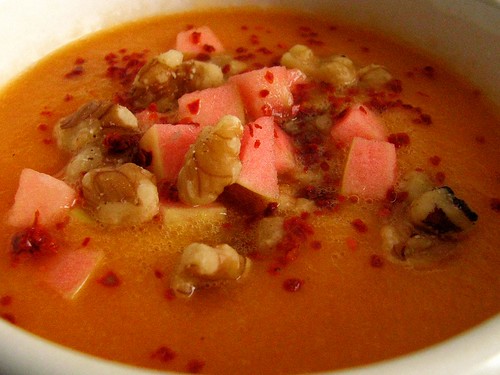
I had about 1 1/2 cups of leftover spaghetti squash, added 1/4 onion, one carrot, cut in half, one cup of water, some sliced garlic and sliced ginger root. I seasoned with red chile flakes, cassia cinnamon and salt and pepper and mixed everything in the VitaMix. (I decided about half-way through mixing to add a teaspoon of cornstarch to help thicken it. I'd have liked it a little thicker, perhaps I'll have some cooked leftover potatoes or sweet potatoes next time!)

One of the fun things about the VitaMix is that it can blend so fast that it makes soup hot. I don't need piping hot soup, so I let it blend for about 4 minutes, maybe a bit longer. Then, I poured my soup into an old tureen from my Gram and garnished with lots of raw walnuts, chopped Hidden Rose Apple, and Aleppo pepper.

Hidden Rose apples are new to me this year, and I love them. They are firm and spicy - not to mention a beautiful and surprising rose color on their interiors. Externally, they are a blushing green, so it is startling to see the pink middles.

If you don't have a VitaMix you can always make soup the normal way, and puree with an immersion or regular blender. A sure way to incorporate leftovers and vegetables into your diet is to remember that you can include them in soup. Never the same twice, I think I'll adopt this approach a lot in the coming months.

Updates, Wasted Food, and Being Thankful.

It seems like I haven't been cooking lately. I have, really, but I feel like it has been nothing so exciting to warrant a place here in the chronicles of CakeWalk. All week, I've been wondering if I'd make it to my Vegan Monday, and technically, no I didn't. I have eaten a fair share of vegan foods, namely smoothies and vegetable drinks. I am finally a proud owner of a VitaMix, and feel like I've never eaten so many raw fruits and vegetables in my life. I do have lots of new vegan recipes bookmarked, but haven't embarked on them officially and I'll tell you why.

Part of the reason is that I've been reading American Wasteland by Jonathan Bloom (he also blogs at Wasted Food). Well, to be honest, I started it, got a couple chapters in, and then have taken up reading three different bread baking books, trying to see if I can calculate my own flour to water ratios to improve my final bread product... But what I have read so far has changed my cooking habits forever.

I'm always looking for the next thing I can make, and I confess that sometimes this leads me to more waste than I'd like. I have been better this year; it was a bit of a New Year's Resolution last January to make less and consume more of what is already made. But this book sums it up in the very first pages, in fact in the first sentences of the introduction:
Every day, America wastes enough food to fill the Rose Bowl. Yes, that Rose Bowl - the 90,000-seat football stadium in Pasadena, California. Of course, that's if we had an inclination to truck the nation's excess food to California for a memorable but messy publicity stunt.

As a nation, we grow and raise more than 590 billion pounds of food each year. And depending on whom you ask, we squander between a quarter and a half of all the food produced in the United States. Even using the more conservative figure would mean that 160 billion pounds of food are squandered annually - more than enough, that is, to fill the Rose Bowl to the brim. With the high-end estimate, the Rose Bowl would almost be filled twice over.
I will say that the rest of the book so far is equally engaging, taking me on a journey from farm waste to supermarket waste, and finally to neglect in the home. I know that a heated political debate could ensue, but I think it's just criminal to have so much waste when we have a real need to feed people. Signs are everywhere in our cities for food pantries, Food Network frequently endorses Share our Strength, and it's Great American Bakesale (sponsored by refined sugar company giants) to help hungry children in our own country. We have this idea in the US that everything needs to be beautiful and unblemished to be consumed - EVERYTHING in our marketing and media focuses on the beautiful, the young, and the airbrushed. Take a head of iceberg lettuce, or a 18 year old model wearing Louboutin shoes, and the treatment is the same: we don't want it if it isn't hyped and wrapped and neatly approved into our massive consumption lives. And we have real need for people who are hungry. (But hungry for fruits and vegetables, or hungry for pre-packaged meals? That is a whole different debate, as well.)

Now, I know that most people I know don't fit into this generalization. We food shop locally, preserve much ourselves, and limit packaged food purchases. But as my Mom was just telling me, gone are the days when the Grandmothers make a soup out of the dregs of the celery.

My Mom's (maternal) Grandmother was the first generation born in the United States. Her name was Laura, but it was supposed to be "Lottie", her mother's accent too thick for the writer of the birth certificate to understand. My earliest memories of soup were from her summer home in the Northwoods, just down the road from our house. Her pea soup, most clearly, I can still taste on my tongue. Surely, it was nothing more than a ham bone and split peas, maybe some onion, but it was so good that it has stuck with me all of these years, and no soup I've ever made has rivaled it. Her husband, my Great-Grandfather Casey, was a DP, also from Poland. Food was especially precious to him, as was his American citizenship. He was detained in a camp during WWII, and when he finally came to America, he brought with him a heel of bread that he kept until he died - a memory of the scarcity of food he came from and the bounty of his new country.

I was very young when I knew them, but remember all of the stories: their foraging for mushrooms that led to the pumping of stomachs, my Grandfather's impossibly thick accent, the rabbit hutches where they kept the pets that I later found to be sources of food, the bonfires and family times that were so important to them both, and ALWAYS contained food.

Waste was never a part of their lives. My Mom would bring us to their little cottage and it would appear there was nothing to eat. Moments later, somethings were made from nothings, and I'm now remembering this daily in my own kitchen. I would never tell someone else what he SHOULD be eating (except my Husband, of course), and would not support Big Brother stepping in to take hold of our food consumption issues. But this waste! It's hard for me not to cook, or to not have many wide, open mouths that want to eat. But, I've been trying to take pleasure in eating my leftovers, and living more reliably out of my home canned pantry.

The trick, I've found, is trying to make much less. My Husband isn't a fan of leftovers, but some things I can get him to eat a second time. Of all of my bread experimenting, I haven't had much waste, but turned what I did have into breadcrumbs. (An infinitely more exciting task since I just got my very own VitaMix! The crumbs are uniform and even the hard crusts are punished into complete dust, and I can't wait to coat something in them and panfry...)

Dinner tonight will be the end of this bread, turned into toasted panino type sandwich. Glamorous, no, but it will be tasty, and then I can make another loaf of bread!


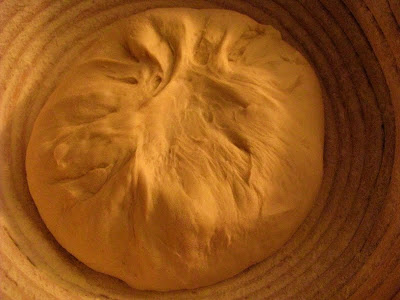
This one, I kneaded until it felt smooth and elastic. I haven't been making much "kneaded" bread lately, in part because I wasn't sure my starter was vigorous enough. Now, I am certain that my starter is active, and strong enough to lift dough. I started this bread at 11 AM, and it rose, was shaped, rose again, was baked, and came out of the oven at 10:30 late last week. One more notable thing about sourdough, is that it seems to have preternatural ability to be fresh. I made this on Thursday, and though not technically "fresh", it is still absolutely tasty - especially as toast. I used this recipe from King Arthur Flour, but omitted the commercial yeast and sugar. After all, I went through the trouble to raise up the starter, I don't mind waiting around for it to do it's job. Yesterday I was reading in Bread by Jeffrey Hammelman, that the incorporation of air into the dough is essential to the raising of the dough. You can do this too much, and run into problems, but I found that this kneaded loaf did rise more quickly than the wetter doughs I just mix and let rest for 18-24 hours. I feel I have volumes to learn, but that's half the fun.


Fall also brings with it low-light photography that challenges my camera...

I also decided that the brotform is best suited to kneaded, 'drier' doughs. I had no problem tipping the loaf out of the basket, and then carefully lowering it into my dutch oven by hand. I was even able to slash into it with the lame, another KAF purchase that was going largely unused. My next several loaves will likely be kneaded, and I may even try to approach my scientific side and pay more attention to the temperature of dough, air and water and the ratio of water to flour.

It still completely amazes me, and it probably always will, that bread is flour and water. That's it. A union that immediately begins the fermentation process when combined, and can satisfy the world over. Almost no bread is ever "inedible", as well. I baked kind of a brick last week, since the dough was too wet and stuck to my brotform so much that all of the air was knocked out of it. It ended up a flat discus of dough, and was still edible. Honesty permits me to tell you, that we ate a little of it, but then I ditched the rest. Waste. That's the price I pay for bread snobbery - and for never being hungry enough. I should not have thrown away that loaf. My Great-Grandparents wouldn't have. My Gram wouldn't have. My Mom was here, and was eating it. But me, bread-snobbish me, decided that I needed to make a better one, and tossed it out so I wouldn't have to think about it.

On my last library trip, I also picked up One Magic Square, in hopes to learn a bit more about packing more into my raised beds next spring. The author, Lolo Houbein, begins the book with her own family history in the Netherlands. As a child in 1944 and 1945, her family survived a famine - and she tells of eating grass scavenged from beneath the snow to "steady her stomach". At 5 foot 8 inches tall, she withered to 75 pounds, but survived. She has tended her own food sources ever since, and inspires others to grow at least a small percentage of their own foods. Another reminder never to take for granted all that America's food has to offer us, and to be responsible and diligent with what we do have. That probably includes that loaf of brick-ish bread I tossed out.

As Thanksgiving approaches, I am thankful for enough food and the knowledge of how to prepare it. I'm thankful that I am the only one in my house that likes squash, and I have 9 (!) of them to figure out how to eat myself thanks to my CSA the past several weeks. I am thankful that as the season grows colder, we can heat our house (and that my baking bread warms the kitchen so that I keep the thermostat a bit lower). I am thankful for my picky-eating family, and never abandon hope that they will someday also like things like squash. I am also thankful that I have many everyday reminders not to waste food.