My Bravest Adventure Yet: Kombucha


GT's brand was my first experience with kombucha, a fermented tea beverage, probably about a year ago. Now through the wonders of friendship and Internet, I can say I will probably be GT's free indefinitely. Starter teas and finishing flavors including different juices, can vary, but the hallmark vinegar bite generally does not, and home brewing of kombucha allows the brewer a hand in controlling the amount of tang in the finished drink. This was certainly one thing that a year ago I would never have envisioned myself making in my home kitchen.

Kombucha is another item in the list of "love it or hate it" type things, due to it's unique flavor profile. I think, for me anyway, kombucha could be likened to cilantro; when I first tried cilantro - sometime in the 1990's I think - I hated it. Really, really hated it. Then, a few days later at work, an indescribable craving for cilantro came over me. I had to have cilantro, and from then on I couldn't get enough. That is how kombucha was, one sip and I was kind of amazed, a day or two later, I was full out obsessed.

Prior to my first sip, I had only generally overheard people talking about kombucha, and had seen it sold for exorbitant prices in the co-op, when I decided to purchase a 16 oz. bottle for about $4.50. I didn't know what to expect, so I didn't know that opening a freshly shaken bottle, in the car mind you, was going to be a really bad idea. About a third of my expensive trial run ended up stickily coating the interior of the Olds, and I learned firsthand about the natural effervescence of kombucha.

While the price of bottled kombucha appears to be going down (I assume in part due to increased competition from other brands), it is by far less expensive to make it yourself. And if you have a need for kitchen projects, as I do, the attraction to this one is purely irresistible. For some reason, I used to think that this was something best left to the controlled environment of a commercial kitchen laboratory, but now that I have been living with a SCOBY for a bit more than a week, any fears I had about home brewing tea from a living organism have evaporated. It is interesting to cohabitate with a culture of this nature, who goes through daily changes, and can perpetuate many generations. It could be the stuff of science fiction, or it could be age old wisdom in the new-fangled guise of popularity. Whatever it is, it is delicious, and it's worth giving a try!

Ok. If you are squeamish, this may be where you want to depart for the day. The kombucha brewing process begins with a SCOBY:
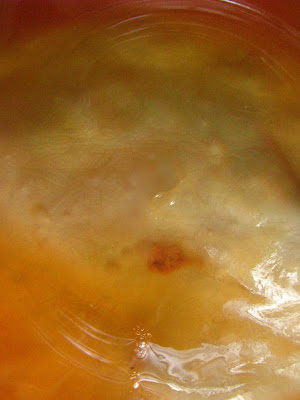

SCOBY, circa day 3 of first batch brewing.

SCOBY stands for Symbotic Colony Of Bacteria and Yeast. So this little guy above, a baby SCOBY given to me by my friends Peef and Lo at the Burp! Blog, is an actual living organism. He feeds off sugar, growing and fermenting the liquid he is in until the tea is ready and full of healthful strains of vitamins, enzymes and acids, usually 7-10 days but as long as 30 days depending on your fondness for vinegar and your sensitivity to sugar. The longer the SCOBY resides in the tea, the more sugar it eats. The final elixir is slightly alcoholic, but contains far less than 1% alcohol, and the SCOBY produces multiple beneficial organic acids during the process.

It seems there is no real medical fact to back up any of the health claims, of which there are many. Even the Mayo Clinic notes that there is no human trial on record to back up any such heath claims. Most fascinating to me, however, are the claims by numerous people of the beneficial effect of glucuronic acid produced by the SCOBY.

Glucuronic acid is touted as having superior detoxifying abilities, and cleans the liver. Cancer and other vicious afflictions such as rheumatism appear to have drastic positive reactions to glucuronic acid, and to the host of other beneficial acids contained in kombucha. It appears the glucuronic acid is best produced in tea stored at a constant 74-84 degrees farenheit, and not as well at cooler temperatures. I'd say my kitchen has been a little cooler than that, but it seems that I've been doing ok so far. There is no shortage of information to be Googled, if you are interested. I found some great overviews here at the Happy Herbalist and here at Food Renegade for starters.

But more important to me than unsubstantiated health benefits, kombucha is adventurous. The name, obviously, sounds very Japanese, and is thought to originate in the far east. According to Seeds of Health, around 415 AD a Korean physician named "Kombu or Kambu" treated the Japanese Emperor Inyko with "cha"(tea), and the result evidently was positive as the tea then took the name Kombucha. Kombucha then migrated to Russia and on to Eastern Europe. (The Seeds of Health link above also outlines the numerous beneficial acids contained in kombucha.) Traveling tea, made from living organisms that, I'm guessing substantiated or not, are pretty darn healthy? Sign me up!

In our food geekery talks, Lo told me of her aunt who had multiple SCOBY's and kombucha batches going. Different teas, green or black, lead to different flavors, and Lo's aunt sounds like she has an awesome "laboratory" to choose from. The culture that Lo chose was from an Earl Grey tea, a tea that generally is considered a poor choice for growing a SCOBY. We both have had good luck so far, Lo in her 3rd or greater batch, and me in my 2nd, using a high-grade Earl Grey tea from Rishi. Burp! Blog will no doubt also be posting on their kombucha adventures, so be sure to check in on their site! Peef and Lo graciously gave me my SCOBY, and a nicely typed and articulated way of brewing my first batch of kombucha. I started a week ago Sunday, and in 7 days, had a batch of tea ready to be bottled.

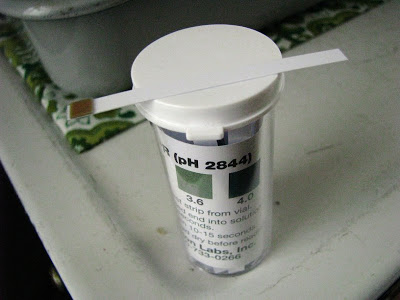
In the interim, I read (and still am reading) tons of information on kombucha, SCOBY's, and the health benefits of both, and also more than once have been sucked into reading disaster stories of how natural things can be bad for you. It does appear, however, that "bad kombucha" will only lead to nausea and vomiting, so it's a risk I'm willing to take. It also serves any adventurous kitchen warrior to take extra precautions when handling a SCOBY: clean, non-latex gloved hands, and a clean environment just make good sense. Another rule of thumb for kitchen experimenters is if it looks funny, smells funny or grows fuzzy mold, best not to chance it and throw it away. Also, I went a step further and after reading about PH levels, decided that I should test for my acid content prior to bottling.


To purchase snazzy swing-top bottles, I visited Northen Brewer. I had never heard of Northern Brewer, and was glad I could not (even with iPhone's help) locate my original destination and had to call my home-brewing friend, Mr. Mork - R1's husband. I have never considered brewing beer myself or even getting that excited about brewing/fermenting, but I guess in the course of culturing buttermilk, yogurt, vegan cashew cheese and sour creams the seeds were planted. This shop was so infinitely inspiring. They had a whole "Grain Room" and refrigerated liquid yeasts from Europe! I got a class sheet, and their catalog to peruse wort chillers and glass lab equipment like a crazy person over my breakfast.

Beer is just fine, but I don't go out of my way to drink it most of the time, and here I am daydreaming over descriptions of hops! I called up Mr. Mork, and asked when his next brewing session would be since now I just have to learn more (without becoming totally committed to home-brew craft all by myself). We set a date for next week, and I am going in like a sponge to soak up all the hands-on information I can on beer brewing, and I hope to have a series of posts on my observations!

The Northern Brewer employee that helped me was completely knowledgeable and the perfect person to continue inspiring me. He was interested not only in fermenting beer, but in lacto-fermentation of pickles and ginger beer plant. I didn't realize at the time we were talking that the Ginger Beer uses the exact same process to ferment as kombucha! He convinced me, easily by the way, to invest in a product called StarSan to sterilize my jars. I did the math, and for a half gallon of water, I only need a single teaspoon of this sanitizer as a rinse for my bottles. I went ahead and sterilized everything I used in a half gallon bowl of sanitizing rinse: funnel, ladle and finally my clean and ready to be refilled 1 gallon glass tea jar.

The next day, I returned to purchase PH testing strips and while waiting to consult with him, overheard him assisting a new home-brewer. He told him it isn't the end result that home-brewing exists for, that it is the whole process of brewing that leads up to the end result. "A Machiavellian approach to life" is how he put it, which put a smile on my face to know that I am not alone in my gusto for reading more into the culinary world than meets the common eye.

He also said that testing my acid levels probably wasn't "necessary", but would be fun to know - exactly what I thought. An article I read said to prohibit the growth of bad bacterias, the acid levels should be between 2.5 and 4.6, mine checked in at 3.2 on day 7, and tasted fizzy and light without being overwhelmingly vinegary, so I decided to bottle. In two of the bottles, I added a little bit of pure ginger juice, since I read that the inclusion of juices can improve the natural carbonation. In the back of my mind, I wonder what the American Dental Association would think of my consumption of kombucha given it's rather high acid levels, but since I am not a soda drinker, I'm not going to let a daily glass of tea worry me.
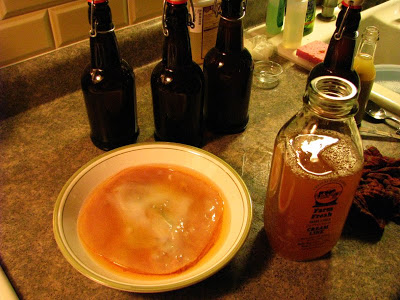

I even dipped the bowl that temporarily held my SCOBY in sanitizer...

I got 4 16 oz. bottles, and about 3/4 of a quart jar of bottled tea, saving out at least 1/2 c. of tea and the SCOBY for the next batch. I was impressed at how thick the SCOBY got in just 7 days. I had almost no trouble separating it, but it did tear just a little. Aready, it appears to be mending itself.
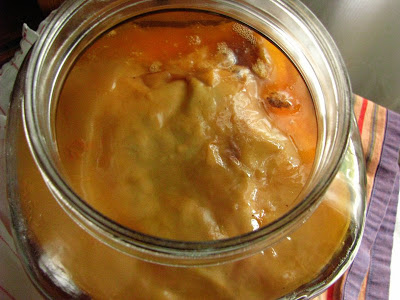

Second batch, day 2: the baby SCOBY.

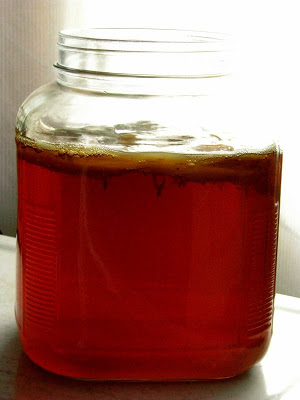
I was also reading that if you want to start your own kombucha and are not fortunate as I was to know someone with an extra SCOBY to get you started, you can take a bottle of purchased kombucha and let a culture begin on it's own. I was a little skeptical that this could work, until I did my own bottling. My quart jar has been out on the counter for two days (I moved it to the refrigerator today), and you can begin to see the growth of a new SCOBY near the top of the photo:
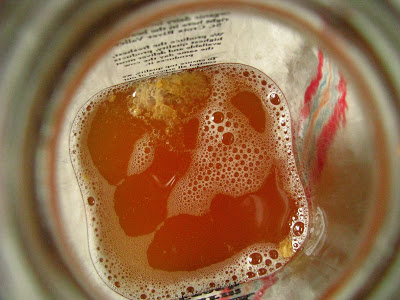


I imagine if you take a bottle of purchased kombucha, pour it into a sterilized glass bottle, and leave it at room temperature, you may discover that it can produce a baby SCOBY. If not, do a bit of research and I'm sure you will be able to find someone willing to share. The keys to any successful project of this sort are research, first person "wisdom of the ages", as the Northern Brewer employee put it, Internet/book knowledge, and old-fashioned common sense.

It's always a pleasure to run into other curious minds, and ones that are gonzo experimenters. For that and so many other reasons, blogging has enriched my life. I am lucky to be able to compare notes on this fascinating process with Lo, and as we both continue to gain knowledge and understanding of our little science projects, I'm sure there will be many posts to come. I will leave it to Lo to come up with some killer flavors, since she towers over me in that department... so you can be sure I'll be checking out the Burp! Blog anxiously to see what experimenting they are up to.

I'm also excited to see where my own blog takes me, now that my culturing obsession is moving forward slowly into fermentation. I have a copy of Wild Fermentation on hold from my library, and I'm sure that will only serve to add fuel to the fire. Just when I think there is nothing new on the food horizon for me, something steps in, confirming to me all the more that I am doing exactly what I should be doing at this point in my life... experimenting, reading, testing and writing about food from the standpoint of my small kitchen.
Vegan Monday: Adventures in Lemon Poppyseed Bread


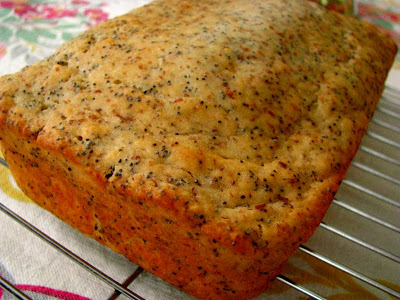
Looks pretty good, so far...

You may notice that I dropped the "raw" from the vegan post title this week. This was intentional, since I fully intended to branch out into vegan bakery. I found a base recipe and of course, altered it to use up more of the almond "pulp" as I like to call it, my homemade by-product of almond milk making. My end result was less than stellar I must say, but for a little sweet something for just myself, I'm reasonably happy.

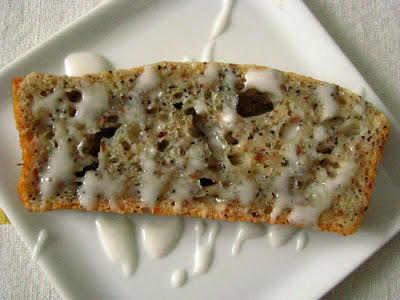
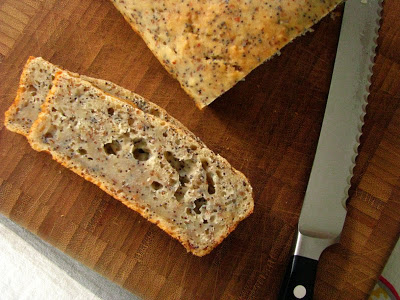
Well, maybe more than reasonably happy, since two of my most favorite flavors are lemon and almond. So many recipes for poppyseed anything contain only lemon, which is fine, but I absolutely crave almond extract - the King of All Extracts in my book. True to my assumptions, the base recipe, one from Robin Robertson's Vegan Planet, uses the zest and juice of a whole lemon. I stayed fairly faithful to her recipe, but accidentally forgot to add the 2 tablespoons of oil, and added in 1/2 c. of my almond pulp. I had high hopes when I tasted the batter; it was perfectly lemony and suspiciously like a traditional quick bread. I just knew that adding my almond extract glaze (which I could practically mainline, mind you) would make it perfect. I baked it for 60 minutes, let it cool in the pan for ten, then waited patiently until it was completely cool to cut into it:


Dense, gummy, and appears to be overworked, not good characteristics for a quick bread. I tasted it. Hmmmm. It was actually pretty good! Especially after I added a little glaze of confectioner's sugar, almond extract and almond milk... it actually improved it so much that I even considered writing down the recipe here for non-discerning and non-judgmental vegan bakers... but I think I better try again and work towards perfection.


Vegan bakery does have the guilt-free aspect working for it. While the recipe does use white flour, it only had 1/2 cup of sugar, half the amount of most traditional quick bread recipes, and no eggs or butter to clog up my arteries. Gummy or not, I wrapped my sad loaf in foil, and tucked it into the fridge for eating alongside my coffee for the rest of the week.

It is always a little sad when something turns out less than your expectations of it, but it becomes almost a blessing to still be able to consume it! It also serves to knock me down a few notches in my experimentation modes, since sometimes, I feel like I could add flour to water and produce something so amazing that no one would suspect otherwise. Egotism has no place in the the kitchen and Venerable Kitchen Wisdom does usually know what is best for you. Lessons can be learned in everything, provided my eyes are open wide enough to see them.

Getting to know Veganism in all it's forms is really fun for me, and a little flop here or there isn't going to deter me! We'll see what happens for next week, Raw Vegan or just plain Vegan Monday will be around to challenge me a little bit longer. I MUST find another use for almond pulp! I refuse to believe that I can't make it into something delicious and worthwhile! Any ideas? Be sure to send them my way...

To Borrow a Phrase: Greek Hippie Salad


I consider the humble wheat berry. It is wholesome, toothsome, versatile, and completely underused in my kitchen due to it's incredibly long cooking nature. I never remember in advance that it should soak for 8 hours prior to it's 1 hour stove-top simmer, and frankly, since I don't know what I'm going to eat from day to day, planning for such ingredient usage is usually out the window unless a dinner party is involved. I do usually have a quart jar stashed under my cupboard, just in case inspiration and planning strike me.

In the past week, I have taken note of 3 separate salads: one with wheat berries, one with crunchy radish and lettuce leaves, and the last one a genre of salads given a great name - Hippie Salads. Starting in reverse order, Marisa at Food in Jars noted somewhere (and I don't remember which post) that her husband isn't always so fond of her hippie salads, salads that are comprised of whole grain and leftover and miscellaneous healthy things. I'd have to say, that my Husband is even pickier than hers, so the concept of Hippie Salad at my house is usually tailored just to suit me for lunches, light dinners, and snacks. I rather like this arrangement, since I determined a while back to no longer make enough salad to feed Guam, and successfully scaled down to accommodate only myself.

As for the crunchy radish and lettuce leaves? Just look here at the beauty that is Veggie Le Crunch! Sprouted Kitchen is really a beautiful, photo driven food blog, but she has some killer recipes as well. I actually fully intended to make a generally the same version of this salad (since I truly am incapable of following proportion and direction), but veered from my course when I stopped by the Outpost today. They had beautiful red and green romaine lettuces on sale, and I for some reason I just had to have a Greek style salad right then and there. I got a cucumber (knowing the leftovers will be tossed in some homemade sour cream that I just made and need to use), and some imported French sheep's milk feta. The bones were laid.

Mid week, Boy-O and I visited R1's place, and I was perusing a magazine and saw the picture for this salad on an olive oil advertisement. I perceived the edamame to be bright green peas, and thought immediately of a pea type version of a wheat berry salad that would be worthy of the new innBrooklyn Virtual Veg of the Month Club. This month's selection is peas and/or pea shoots, and while I haven't scored any fresh from the Wisconsin earth peas yet, the hippie salad I concocted used a healthy amount of the frozen variety.


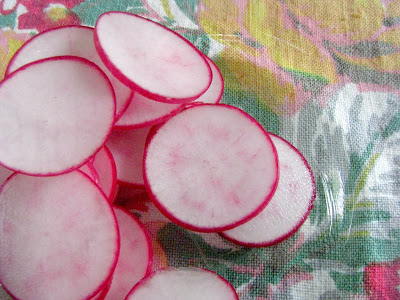
A couple of thinly sliced and quartered radishes that I had to buy earlier in the week after drooling over Sprouted Kitchen's Veggie Le Crunch.

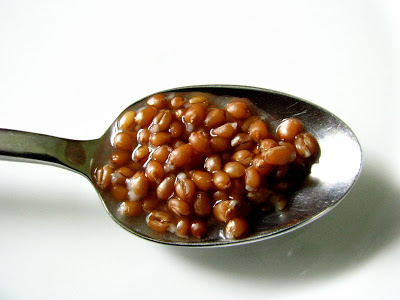
When I have inspiration, it's easy to concoct, but I still had the pesky problem of the soaking and cooking of the wheat berries. I didn't remember last night that I wanted to cook some today, but I did know that I did around noon. I figured since I love my pressure cooker for pinto beans (and had used it yesterday and still had beans leftover), I would use it for the wheat berries. Thanks to this site, I found charts for pressure cooking everything! I soaked a half cup of rock hard berries in 3 times their water, and went to a birthday party across the street. When we got home around 4, I put them in the pressure pot with plenty of water to cover them by at least 2 inches, and cooked them on medium for 30 minutes. I quick-released the pressure by running the pot under cool water, and was rewarded by perfect, fat berries ready for a Greek Hippie Salad!


As with all hippie salads, you can omit, add or augment however you see fit. My half cup of raw wheat berries yielded a bit more than a cup of cooked berries. All told, my salad was a bit over 2 1/2 cups. Instantly veganize your salad by omitting the feta.

Greek Hippie Wheatberry Salad (inspired by the sources above)
  • 1/2 raw wheat berries, cooked using whatever method you prefer
  • 2/3 c. frozen peas, cooked in boiling water until done - 3 to 4 minutes
  • 1/2 cooked beans, I used pinto
  • 1/3 cucumber, peeled, seeded and finely chopped
  • 2-3 radishes, thinly sliced and quartered
  • 1 1/2 oz feta cheese, imported sheep's milk is strongest
  • 2-3 T. chopped red onion
  • 1/2 lemon, juiced (about 1 1/2 T.)
  • 2 T. extra virgin olive oil
  • 1/2-1 clove garlic, minced or grated on a microplane
  • 1/4 t. oregano
  • salt and pepper to taste
  • romaine lettuce leaves for serving
In a small bowl, combine lemon juice, olive oil, garlic, oregano and a little salt and pepper. Whisk to emulsify into a dressing. In a larger bowl, combine all other ingredients and toss gently with dressing. That's it! Serve it on the lettuce and add a little more black pepper if you like.


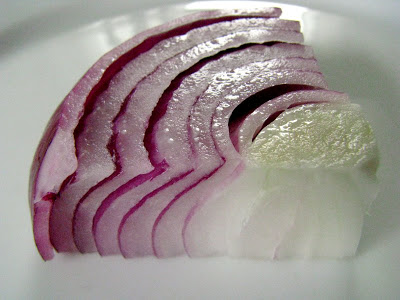
I tasted it and loved it, of course, since I made it to suit exactly what I had a taste for. I didn't originally add red onion, because I didn't think I had one - but luckily I found one that was in desperate need of using, so I added it after the photos. It was the the missing link. I then thought I could have gone and added red and green pepper, and even some other colorful and hotter peppers, but I'll save that for next time.


The missing component.

Hippie salad, or not, my Husband thought he'd even try a bite, though he hasn't yet. I ate mine rolled up in a lettuce leaf like a taco, and then had to have another big scoop on the side. I'd bet the avocado dressing that Sprouted Kitchen made would be good as a wheat berry salad dressing... but then I'd bet that each and every reader could add or subtract one thing that would improve upon the Greek foundation that I was craving this chilly June day.

How many salads have you seen that just call your name and have to be made? I know I'm not alone, when it is a numberless amount for me. They are probably one of my favorite things to make and eat, which is a lucky predicament to be in indeed. I find, that any kind of salad of this nature, stuffed into a tortilla (homemade of beans or corn masa), garnished with cheese and hot sauce is pretty much foolproof.

Not sure how this Greek version would fare in my my old standby, but I have a feeling I'll be making some flat breads after church tomorrow...

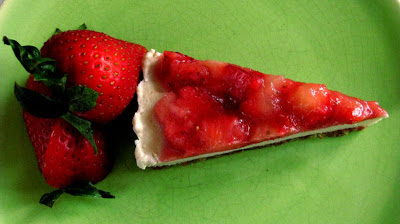
Raw Vegan Monday: Strawberry Cheesecake

It would seem that I can not help myself with my self-imposed Raw Vegan Mondays. I didn't really think I would do it this week, but I guess I changed my mind last night when I was looking for more dessert options...


Because I wanted to keep it raw, I thought I would search for a nut-free raw crust. If you know of any recipes out there, please let me know! I searched high and low on the Internet, and couldn't find one. I'd imagine this would pose a problem to someone with a nut allergy wishing to eat this way, but really I was thinking about myself.

Most raw vegan desserts I've been seeing are very nut heavy. In fact, this cheesecake is based entirely on a creamy cashew center. Of course, I could just opt for a bowl of fruit, but what fun would that be? Last week's Chocolate Pudding Pie was so good (and lasted very well, by the way, we had the last slices after our Beet Gnocchi dinner Saturday night), that I thought it would be hard to beat. Certainly, it is if you love chocolate... but if you love cheesecake, let me introduce you to this raw vegan version.

I found a base recipe at Gone Raw, but then proceeded to cut some nuts and sweetener from it to result in a not quite as nut-heavy endeavor. My cheesecake is light and refreshing, and can be stored in the freezer - a total plus for a daily dessert indulger such as myself.


I happened to have a lot of preserved lemon and no fresh lemon, so I used it. You could also use grated lemon peel, or add a touch of lemon juice if you have fresh to work with.

Raw Vegan Strawberry Cheesecake (adapted from Bees Knees Kitchen via Gone Raw)

Makes one 8 inch springform pan (I used my tart tin, since I don't have a little springform)


Crust:
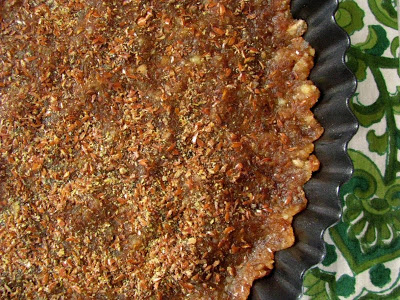
  • 1/2 c. walnuts, ground to a "flour" in a spice mill
  • 16 dates
  • 1 T. water
  • pinch of salt
  • flax meal, to achieve proper consistency
Process the dates in a food pro until they are well chopped. Add the walnut flour and pinch of salt and pulse to combine. Test the consistency - I added 1 T. of water, then added a bit of flax meal to achieve my ideal. Press into an 8 inch tin, I left mine mostly on the bottom and not up the sides. It is a very thin base.

Cheese Filling:
  • 1 1/2 c. cashews, soaked in plenty of filtered water overnight
  • 1/4 of a preserved lemon (rinsed thoroughly and flesh removed, peel sliced thinly)
  • 2 T. coconut concentrate
  • 1 T. raw agave nectar
  • 1 T. brown sugar
  • pinch of salt
  • 1/2 t. vanilla extract (not raw, so you could use vanilla seeds scraped from a pod)
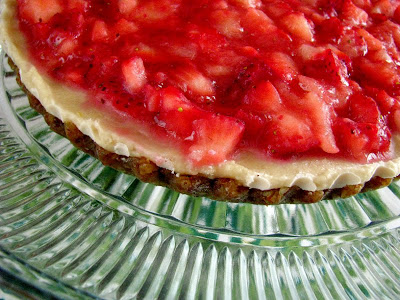
Blend all ingredients in a blender or food pro (or VitaMix for the creamiest result). I got pretty smooth by using my hand held immersion blender on the cashews first, with about a tablespoon of water to get them going. Then I transferred them to the food pro and continued with the blending and adding of the other ingredients. Taste and adjust the sweetness level to your liking. Spread over the crust in the 8 inch tin.

Strawberry Top:
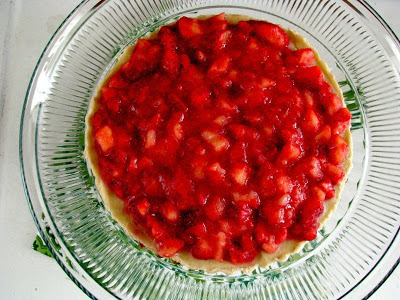
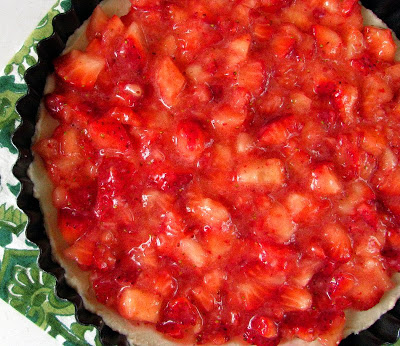
  • 1 heaping cup chopped strawberries
  • 1 t. agave nectar
Pulse in a blender (I used my kitchen shears to cut up the strawberries, and that worked fine) until coarsely chopped and releasing some juice. Spread over the top, to within a half inch of the sides.


I put my cheesecake right into the freezer, and then took it out after lunchtime to slice it. It cut into nice neat slices and tasted delicious! Light, slightly lemony, and not at all too rich like a conventional cheesecake. I think if you like icy cold things as I do, it's perfect right from the freezer, but I am also going to try letting some defrost in the fridge for a few hours before eating to test it at another temperature. I cut my whole tart into slices (I got 9 plus the one I ate...) and froze them in a container between sheets of waxed paper, so I can be assured of dessert for at least a week to come. I may try a balsamic reduction one day too, but then it would involve cooking...

I really think that raw vegan desserts are so attractive to me in part because I really do feel less guilty about eating some every day. I tend to eat them slower and savor them more than traditional desserts, I don't know if that is because I'm trying to read into the flavors more or what. While again, I can't promise yet another week of Raw Vegan Monday, I know that this is one diet and foods experiment that is going to linger on for some time!


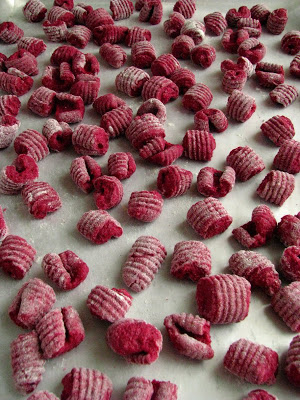
Beet Gnocchi. Enough Said.


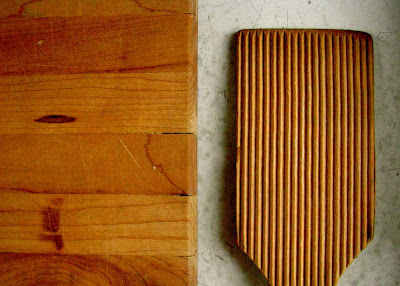
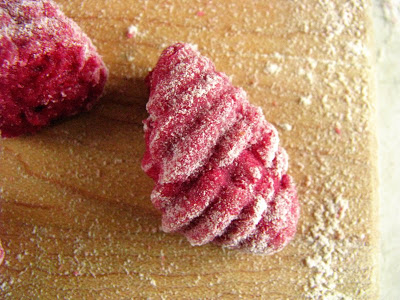
This is only the second time I have ever made gnocchi. Or eaten gnocchi. A few years ago, I was watching Mario Batali make it on the Fine Living Network, and I had a revelation. He made it look so easy! Like I should just be able to do it tonight, while conversing with friends over a glass of wine. I also discovered during that Molto Mario episode, that I personally owned a gnocchi paddle. My Mom had given me a bunch of kitchen tools, probably from an auction or rummage, and among them was this paddle. When I had limited wooden utensils, I tried using it to stir and couldn't fathom why it would have grooves. It seemed like the worst idea ever for a kitchen implement. It spent a long, lonely decade in the bottom of a drawer before, fortuitously, Mario showed me it's intended use, and thanks to his enthusiasm, I went right from the couch to the kitchen and made my batch. After all, if I had this neglected piece of kitchen software, I may as well put it immediately to good use.


InnBrooklyn's Veg of the Month Club selection this month is beets, and I felt a particular inclination to outdo myself, since it was my beet pasta experiment that first attracted them to CakeWalk as readers and now to me personally as "froggers" (friends+bloggers). I actually was acquainted with them first through a connection at flickr, and ever since I feel like I'm chatting with old friends when we write (or now Skype) on a fairly regular basis. I feel renewed in my creativity since joining forces with them for LIFEyear, our 365 photography project, and am really happy that I was able to forge such a meaningful connection with people so far away, that I would never have met if it weren't for the Internet!

I also personally wanted to try making gnocchi again; my first attempt with plain russet potato was alright, but far from perfect. Since I really had no way of knowing, I made the dumplings, and then let them sit covered at room temperature for several hours until I boiled them. I've learned since, that if you don't intend to boil them right away, you should freeze them in a single layer on a sheet pan, and then pull them directly from the freezer and introduce them to the boiling water when needed. I'd say I'm still a ways off from perfect gnocchi, but at least I'm having fun and gleaning a bit of extra nutrition along the way.


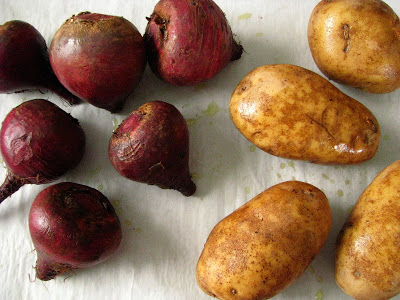
I used Mario Batali's recipe for gnocchi, but used 1 part beet to 2 parts russet potato. I also opted for roasting the beets and potatoes, to preserve the color in the beets - boiling tends to wash them out.

To roast the beets and potatoes, preheat oven to 375, lightly coat them (unpeeled) with olive oil, and let them stay in there until a piercing knife yields very little resistance. The beets will likely take longer, so start them 20 minutes before adding the potatoes. When they are done, cool them just enough so that you don't burn yourself when handling them, and then scrape off the skins. You'll want to rice them (or finely shred them) when they are still warm, but more on that below.

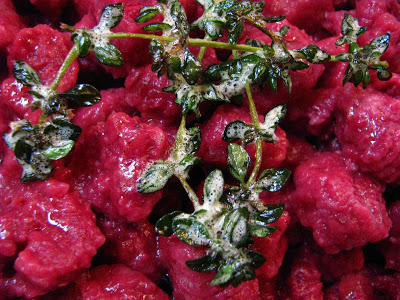
Beet Gnocchi (adapted from Mario Batali) with Brown Butter and Crispy Lemon Thyme

makes 4 main courses or 8 side portions, but I suspect this will vary with your state of hunger.
  • 1 lb. beets, roasted
  • 2 lbs. russet potato, roasted
  • 2 cups, AP flour (plus additional for rolling)
  • 1 egg
  • pinch of salt
When potatoes are roasted and peeled, use a ricer to finely grate them onto a clean sheet pan. (I have no ricer, but one is now on my list! I rub them through a fine stainless sieve which works well.) If you have a ricer, it may be strong enough to rice the beets, but since I don't, I cut them into large chunks and processed them finely in my food pro. Then, I added them on top of the potatoes, and let them cool slightly.

Mound the beets and potatoes together to make a brilliant pink mass, sprinkle liberally with about a cup of the flour and a pinch of salt, then make a well in the center. Crack in the egg, and beat well, adding more of the flour to the egg and then mixing it in well with the egg. When you have a dough forming, knead it by hand gently into a ball, continuing to add flour as needed, until you have a relatively smooth ball that isn't too sticky.

Have two sheet pans lined with wax paper or parchment paper ready. Cut off small portions, and roll into long "snakes" a little larger than the diameter of your thumb. Use plenty of flour (I found that I actually kneaded more flour into the small portions prior to rolling them out into snakes), to keep them from sticking. Using a sharp knife, cut them into 1 inch portions.

When you have a "snake's" worth of dumplings, roll them across the gnocchi paddle or the tines of a fork. (A good explanation of how to do this: here.) Dust the resting gnocchi with flour if they are sticky, and keep them in a single layer. If you are making them for later, freeze in a single layer, then transfer them to a jar or zip top bag and store in the freezer.

Bring a kettle of water to a boil, and add a bit of salt - as if you were cooking pasta. When the water is at a rolling boil, add gnocchi. (Mario has a bowl of ice water standing nearby to stop them from cooking as you remove them. I will remember to do this step next time! Mine were a touch sticky since I didn't.) When gnocchi floats to the top, remove them from the boiling water using a slotted spoon and plunge them into the ice bath. Let them sit there for a minute, and then drain. Mario tosses them with oil to hold them, but I did not since I made browned butter.

Browned Butter with Lemon Thyme
  • 3 T. unsalted butter
  • 3 or 4 sprigs of lemon thyme
In a small saucepan, heat butter over medium heat until it begins to foam. Add thyme (it will crackle and spit at you), and continue to heat until the butter turns brown. Watch it carefully or it will burn. Spoon the butter over the finished gnocchi, and garnish with crispy thyme.


I wasn't sure what to expect when I took the first bite of hot beet gnocchi. Since I had neglected to do an ice bath, they were a bit sticky... Happily, they tasted terrific with a deep, beet-y flavor, and a very dumpling-esque texture. I had a gnocchi expert for dinner, since Sasa grew up eating it, and she told me that the texture was good, so I'm taking her word on it. I really don't think I have ever eaten gnocchi anywhere, so I have some more homework and experimentation to do. If anyone has a good recommend of any Milwaukee area restaurants making exceptional gnocchi, please let me know so I can go and eat it! I feel like I should have added more flour to my dough, but found myself likening it to egg pasta dough, which definitely can not be an accurate comparison.


Since I heeded Ina Garten's advice of never cooking anything you have never cooked before when you are having company for dinner, I had a fresh loaf of bread and a big slow cooker full of shredded Italian Beef ready before I even brought my kettle to a boil... and Sasa told me that in Croatia, they always had gnocchi with a beef sauce kind of like a goulash.

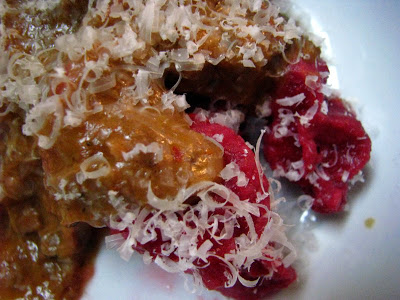
She easily convinced me to experiment with a portion of plain, un-butter-sauced gnocchi. We heated a pan over medium heat and added a tablespoon or so of leftover browned butter. Then, I made a roux by adding an equal amount of flour and stirring it for about a minute. I added maybe a half of a cup, all told, of warm water, and continued stirring with Sasa adding salt, aleppo pepper and finally, a good amount of sweet smoked Spanish paprika. Lastly we stirred in a heavy cupful of shredded beef and let it turn into a sauce:


I grabbed my camera, and she told me that maybe it wasn't the most photogenic thing. I agreed, but was it tasty! We all mixed everything together as we ate, grating Parmesan cheese over our whole plates, and devouring all but about 11 little gnocchi. It was suspiciously quiet during dinner, so I know that it is certainly a meal that I would make again, and hopefully soon, since I only cooked half the amount of beet gnocchi that I froze.

I may be hesitant to join more organized groups, but I have to say I really like participating on a whim to "round-ups" such as the Veg of the Month Club, and Buttermilk Party Cake's Elevenses sweets. I do think that it forces me to be creative in my kitchen, if for no one else, then for myself. My Husband detests beets, and they are one of my favorite things, so I was very happy to have fellow beet lovers to enjoy my hard work with. If you love beets and have a beet recipe you want to share with others, consider submitting it to innBrooklyn before May 9, 2010. I know I'll be eagerly searching their results on the 10th for my next beet adventure!